
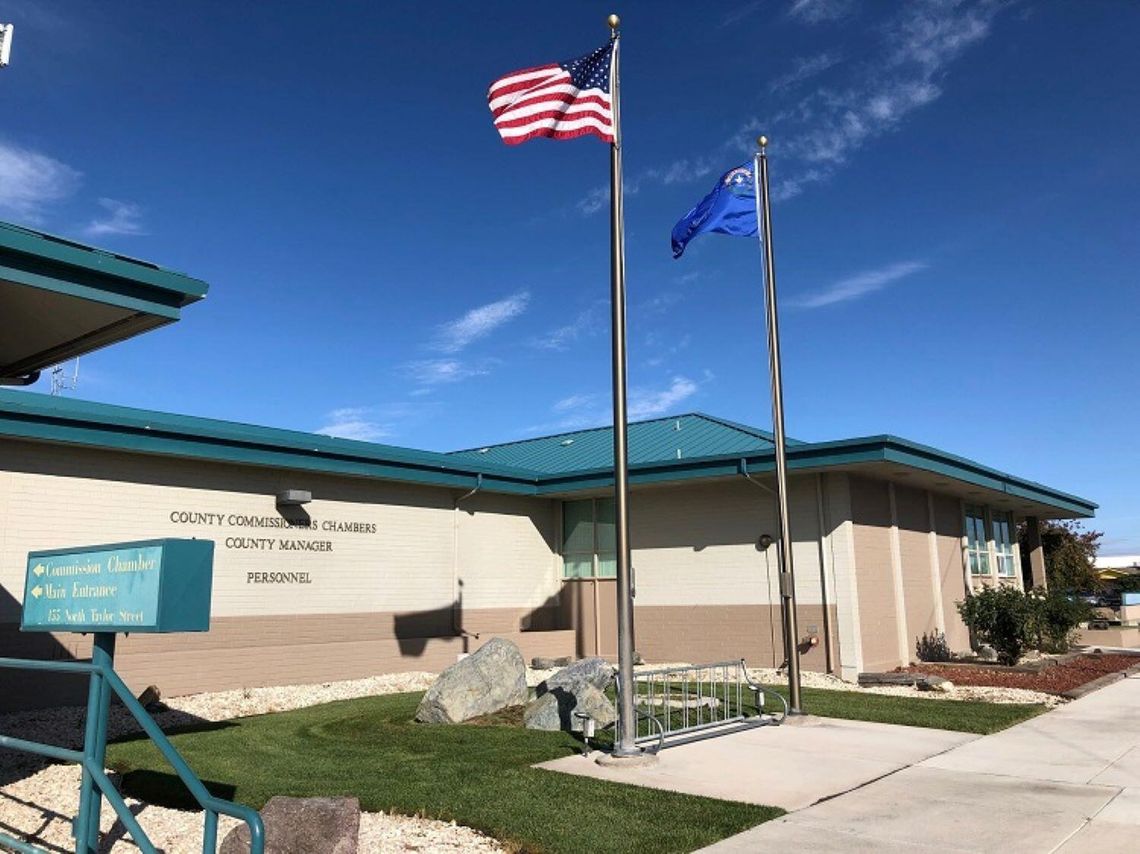
County Commissioner Eric Blakey gave a report to the Nevada Legislature Interim Public Lands Committee last week in Fernley, outlining the status of the Navy expansion, related land transfers, power infrastructure, grazing and mining concerns, and wild horse management.
Blakey said implementation of the Fallon Range Training Complex modernization has been one of the county’s most significant public-lands issues since work began nearly a decade ago.
Congress authorized the expansion through the fiscal year 2023 National Defense Authorization Act after years of environmental review and negotiations involving Churchill County, the Navy and other affected counties.
The expansion significantly increased the size of several military training areas across Northern Nevada.
The Dixie Valley Training Area was enlarged but remains open for most public access and traditional uses. Bravo 16, southwest of Fallon and extending into Lyon County, roughly doubled in size and is expected to become the first range closed under the expansion.
Blakey said Bravo 16 is used for Navy SEAL training and is considered critical to the military mission at Naval Air Station Fallon.
Bravo 17 to the north and Bravo 20, east of Fallon, were also expanded. Those areas will move from multiple-use public land to primarily military use, with limited exceptions that may include escorted access and controlled big-game hunting.
Blakey said the county understands the importance of the training mission but wants the commitments made alongside the expansion to be carried out as intended.
The county’s concern is that all parties should move through the implementation process together rather than allowing range closures to move ahead while related mitigation projects fall behind.
One of those commitments is the reconstruction of Lone Tree Road, which will continue to be used by both the Navy and local residents.
“The commitments made in the NDAA need to be honored by the Navy, and those commitments are key mitigation measures for both the county and the citizens,” Blakey told the committee.
The federal legislation also included land provisions intended to help offset the effects of the military expansion.
Churchill County resolved its remaining wilderness study areas through the legislation, although Blakey said the county has not yet seen completed management plans for those areas.
The county is also working with the Department of the Interior, the Bureau of Land Management and the Navy on land conveyances, exchanges and public-purpose transfers around Fallon.
Those parcels are expected to support community expansion and economic development, but Blakey said the county has been frustrated by the pace of implementation.
“We have a bit of frustration by the slow pace of the implementation of these aspects of the lands bill, but we are remaining fully engaged and involved at every measure,” he said.
Churchill County is also reviewing a long-term process to address checkerboard land ownership in the northwestern portion of the county.
The checkerboard pattern alternates federal and private ownership, often in 640-acre sections. The county continues to work with the BLM to identify where federal parcels would be more useful in private ownership and where private parcels might make more sense under federal management.
Power availability has also emerged as one of the county’s sharpest concerns.
Blakey said Churchill County needs additional electrical capacity to support residents and economic development but has been frustrated by the lack of local upgrades from NV Energy.
The county has worked with BLM and NV Energy on minor alignment changes to the Greenlink North transmission project. However, Blakey said the county sees no clear way to connect to the major transmission line as it crosses Churchill County.
The concern is that a large power line will run through the county without providing local access for new businesses, industrial projects or residents.
Blakey said the lack of available power is already limiting economic growth.
Sen. Ira Hansen said lawmakers may need to ask NV Energy to explain what is preventing greater coordination with the county.
Blakey welcomed the help.
“I truly do believe that the power issue that we have is preventing economic development,” he said.
The county is also tracking several proposed mining projects near lands affected by the Navy expansion.
Blakey said a significant number of mining claims were affected by the military withdrawal and that Churchill County has advocated for fair compensation for claim holders.
He also discussed the federal listing of the Dixie Valley toad and the effect of that decision on Ormat’s Dixie Meadows geothermal project.
On greater sage grouse, Blakey said the county wants Nevada to retain management authority and avoid a federal listing under the Endangered Species Act.
Wild horse management remains another concern.
Blakey said nearly all Churchill County herd management areas overlap with Navy operations, sage grouse habitat or both.
The county supports maintaining horse populations at appropriate levels for the health of the animals and to reduce conflicts with other public-land uses.
When asked how the Navy manages wild horses on military-controlled land, Blakey said he did not have an immediate answer and would need to follow up.
Churchill County remains supportive of Naval Air Station Fallon and the military’s role in the local economy. During the discussion, Blakey agreed with an estimate that the base accounts for roughly one-third of Churchill County’s economic activity.
The county’s message to lawmakers was not opposition to the Navy mission, but a call to complete the commitments that accompanied the expansion.
The county accepted the loss of access to large areas of public land in exchange for transportation improvements, land transfers and other mitigation measures. County officials now want those local benefits to keep pace with the military expansion.



















Comment
Comments