
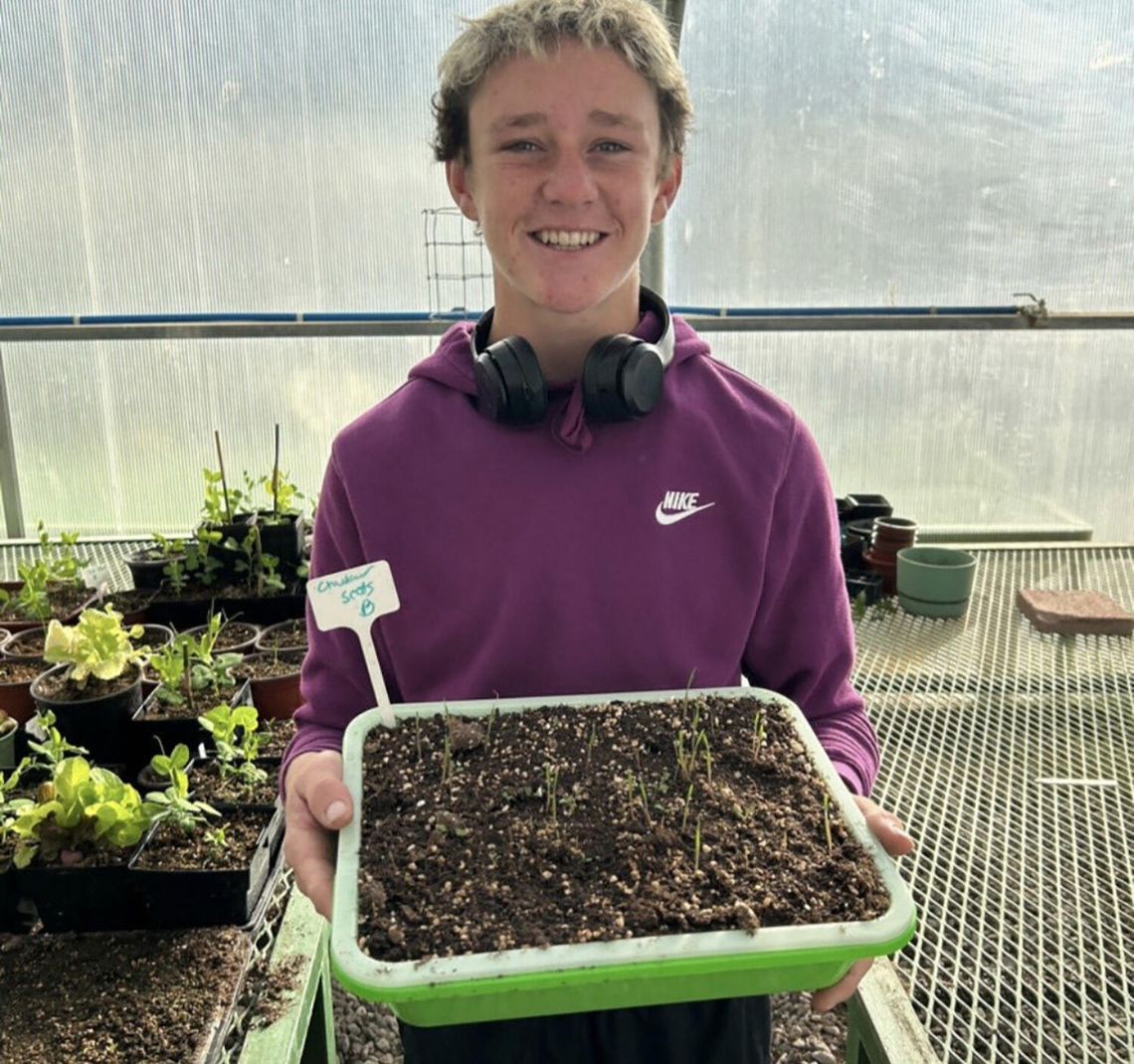
My name is Braylon Byrd, and I am a sophomore this year in Plant Science 1. I have really enjoyed my time in this class. It is a complete change of pace from my normal day at school. I can learn about something I love and see the growth that results from my care. Plant science has totally broadened my horizons — both as a plant scientist and as a person. On any given day, I might be working in the greenhouse to grow plants for our school garden, transplanting seedlings for my own garden at home, or planting trees outside my classroom to brighten up our campus. I always feel like I am making a positive difference to my school and to the world.
My favorite thing I have learned about so far in Plant Science is about riparian environments and the plants that grow there. My family spends quite a bit of time outside together, hunting, for instance. We often find ourselves in riparian environments. These are places where important ecosystems survive and thrive near water. It might not be the first thing you think of when you think about our valley and our small desert town, but it is truly a crucial part. The Carson River, Lake Lahontan, the Stillwater Marsh, and countless other pockets of water in the Lahontan Valley are dependent on keystone species such as cottonwood trees, willows, and even animals like beavers. I really enjoy learning about all of the distinct ecosystems in our state and spending time in them firsthand.
Recently, we planted cottonwood and coyote willow cuttings that we will be taking to the Stillwater National Wildlife Refuge to help with a restoration project there. We hope to help create more usable habitat for all the animals that call the refuge home.
Taking cuttings, we have learned, is an easy way to make new plants. The cutting you take will be a clone of the original plant. Take your cuttings in the early spring, just before the buds break. We each planted cottonwood cuttings that were about seven inches long in potting soil. We then planted them in one-gallon containers about two weeks ago. They are starting to leaf out in our greenhouses now. Did you know that cottonwood trees are dioecious? That means there are male and female cottonwood trees. Spring is a good time to tell them apart. Male trees have red/purplish catkins, and female trees have greenish-yellow catkins. It is the female trees that make the cottonwood fluff.
Resinous cottonwood buds have long been used in our country to make a medicinal salve often called Balm of Gilead. If you happen to walk by a cottonwood tree in the next few weeks that is covered in buds, pull one off and see if you like the smell. Bees also often collect sticky resin from trees to make propolis in their hives.
Cottonwood trees are iconic symbols of the West. The bright yellow and gold that covers our valley in the fall because of the cottonwoods' leaf change is a sight to see. I am glad to know that my fellow classmates and I will not only be contributing to that legendary fall color but to the important riparian ecosystem that is an essential part of our valley.



















Comment
Comments