 Leanna Lehman
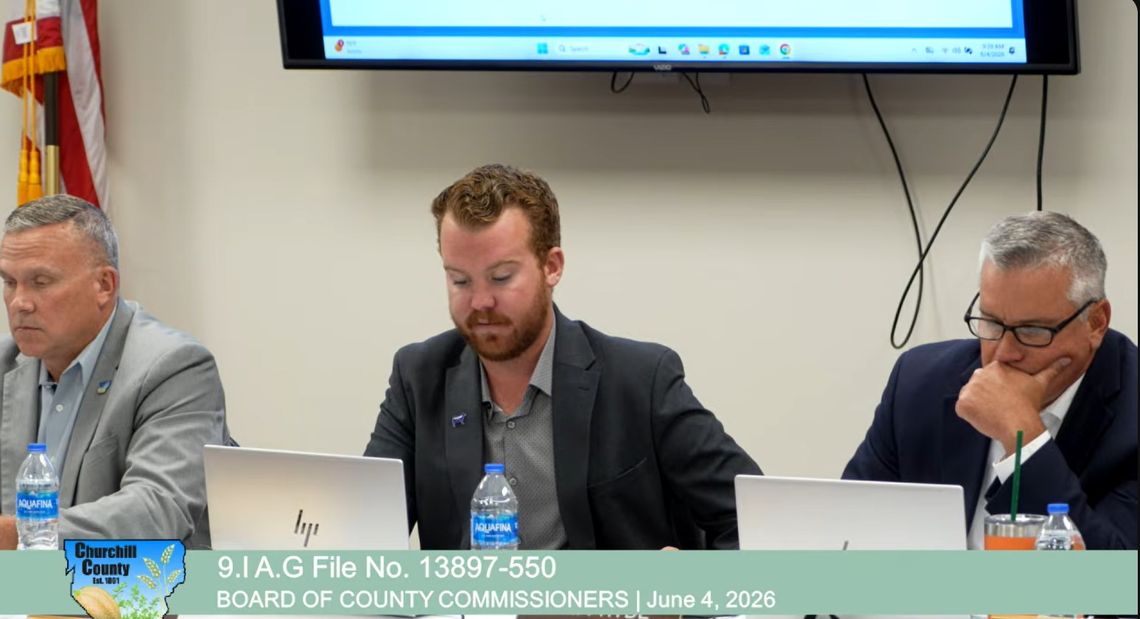
Churchill County commissioners formally acknowledged findings from the Nevada Attorney General during the June 4 commission meeting, concluding the county violated Nevada’s Open Meeting Law during the 2025 hiring process for county manager.
The findings stem from a complaint filed June 12, 2025, by Fallon attorney and former Churchill County School Board Member R. Clay Hendrix regarding the county’s recruitment and selection process that ultimately resulted in Chris Spross being appointed county manager.
The Attorney General’s investigation was triggered by an Open Meeting Law complaint filed by Hendrix on June 12, 2025, accusing the county improperly conducting portions of the county manager hiring process outside publicly noticed meetings.
In the complaint, Hendrix, who had applied for the position, alleged violations of due process, equal protection, and state hiring standards. He named multiple defendants in both their individual and official capacities, including Commissioners Myles Getto, Matt Hyde, and Eric Blakey. Additionally, the suit named Jim Barbee, who previously served as county manager; current County Manager Chris Spross, who recently submitted his resignation. Deputy District Attorney Joseph Sanford, District Attorney Art Mallory, and the Churchill County District Attorney’s Office were also named, along with Mayor Ken Tedford and ten other defendants that Hendrix believed were involved or liable.
In addition to the complaint, Hendrix filed a federal lawsuit alleging the county’s hiring process was improperly handled and unfairly favored Spross, who at the time served as assistant county manager. On April 15, commissioners approved a $5,000 settlement agreement resolving the lawsuit between Hendrix and the county.
Chief Civil Deputy District Attorney Wade Carner told commissioners that the county had recently received the Attorney General’s findings and conclusions.
“This item is just to acknowledge receipt of that findings and conclusions and to allow us to submit a response related to the legal complaint in regards to that,” Carner said.
Commissioner Eric Blakey asked whether the county intended to dispute portions of the findings.
“The statute allows for a response, but it’s unclear as to what happens after that,” Carner responded. “I would hope that the Attorney General would read and consider our response and potentially issue a settlement, but I can’t guarantee that.”
Blakey also asked whether commissioners would have an opportunity to review the county’s response before it is submitted. Carner replied that the county is operating under a limited timeline to respond.
The Attorney General’s Findings of Fact and Conclusions of Law, dated May 20, 2026, concluded Churchill County violated Nevada’s Open Meeting Law by allowing candidate deliberations and recommendations to occur through a working group and recommendation panel outside publicly noticed meetings.
According to the findings, the issue traces back to April 3, 2025, when then-County Manager Jim Barbee formally submitted his resignation and presented a recruitment plan to commissioners for approval. The board approved the plan by a 2-1 vote.
Under the approved plan, Barbee was authorized to create a recommendation panel of up to three members tasked with reviewing applications and narrowing the field to approximately three to five finalists for interviews before the county commission.
The plan also assigned Barbee and Human Resources official Kim Brontsema responsibility for prescreening applications before forwarding them to the panel. Brontsema was additionally directed to compile scoring sheets and “help reach a consensus” among panel members.
According to the Attorney General’s findings, the recommendation panel ultimately consisted of Barbee, Fallon Mayor Ken Tedford, and former Churchill County Commissioner Justin Heath.
The Attorney General determined that after the prescreening process, panel members collectively reviewed applications, scored candidates, and reached consensus on which applicants would advance to interviews before the commission.
However, no meetings of the recommendation panel were publicly noticed or conducted in compliance with Nevada’s Open Meeting Law.
The findings further stated the panel’s recommendations directly determined which candidates were interviewed by commissioners and noted commissioners did not independently review all applications before interviews occurred.
Nevada’s Open Meeting Law is designed to ensure the public can observe how government decisions are made, particularly when those decisions involve public funds, public employment, or official actions by elected bodies. In simple terms, the law is intended to prevent government business from being conducted behind closed doors without public notice or oversight.
Under Nevada law, meetings involving deliberation, recommendations, or collective decision-making by public bodies or appointed committees generally must be publicly noticed, open to the public, and properly documented.
The Attorney General’s opinion explains that Nevada’s Open Meeting Law broadly defines a “public body” to include not only elected boards, but also advisory groups, subcommittees, and working groups created by those boards if the groups are authorized to make recommendations influencing official decisions.
The Attorney General concluded the county’s recruitment process violated the law in two separate ways.
First, the Attorney General determined Barbee and Brontsema themselves constituted a “working group” because the commission formally assigned them joint responsibilities within a structured hiring process approved by the board.
The opinion states their collective review and handling of applications amounted to “deliberative activity” because their actions shaped which candidates advanced through the hiring process.
Second, the Attorney General determined the recommendation panel also qualified as a public body because it was specifically tasked with reviewing applications, scoring candidates, narrowing the applicant pool, and recommending finalists to the commission.
The opinion rejected the county’s explanation that the panel was merely a consultation group made up of community members. Instead, the Attorney General concluded the panel exercised meaningful influence over the final hiring decision by determining which candidates advanced to public interviews.
The findings repeatedly emphasize that narrowing candidate pools and collectively scoring applicants outside a publicly noticed meeting constitutes “action” under Nevada’s Open Meeting Law.
Although the Attorney General found violations occurred, the opinion does not invalidate Spross’ hiring or impose any financial penalties. Instead, Nevada law requires the commission to formally acknowledge the findings during a public meeting and include the Attorney General’s opinion in the meeting’s supporting materials.
The opinion was issued by Deputy Attorney General John M. Nolan on behalf of Nevada Attorney General Aaron Ford. During the June 4 commission meeting, commissioners voted unanimously to acknowledge receipt of the Attorney General’s investigation findings and authorize the District Attorney’s Office to submit a response.







Comment
Comments