
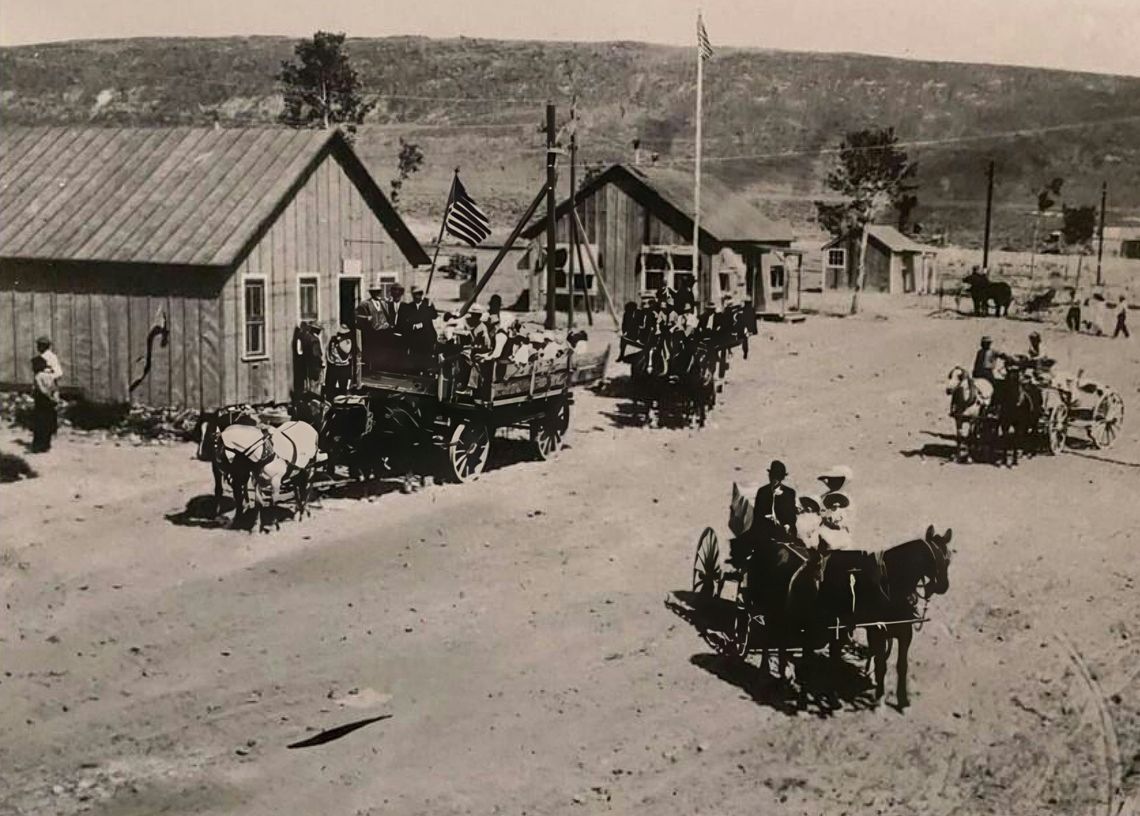
Lahontan City
Let’s take an imaginary Sunday drive from Fallon toward Lahontan Dam to, say, check out the water level and dream about summer swimming and boating. About 17 miles out, on our left is the road leading to the dam and park area, but let’s drive about a quarter of a mile on and look to the right. You will see the remains of a round brick structure and a tall chimney. Now let’s allow our imaginations to conjure up the past. There it is. Lahontan City, right next to the railroad tracks.
At its peak in 1912 or so, it would have been a sight to behold. Lahontan City was established by the Bureau of Reclamation (BOR) as a federal company town to house workers employed to build the dam. At that time, the closest town that could (maybe) accommodate them was Fallon, but the 17-mile commute by wagon or primitive automobile from there to the dam site would have been challenging, to say the least. The roads were sandy and sometimes completely impassable. Thus, the BOR decided to construct their own home base, complete with lodging and dining facilities.
The result, Lahontan City, included a large mess hall, which served 300 workers per shift. Large, round brick ovens were designed to bake hundreds of loaves of bread. The mess hall doubled as a social center where dances and other community events were held. Families arrived and built small houses. Single men lived together in dormitory-style facilities. A post office opened with, of course, a postmark reading “Lahontan, Nevada.” A schoolhouse was opened in 1916, but, by then, the dam was completed and families were moving on. It closed in 1917.
Alfred Cooke and his family arrived at the dam site in 1912, at the height of Lahontan City’s glory. His father, Joe, worked for the United States Reclamation Service and was assigned a job as foreman on the Lahontan Dam project. Cooke’s memories of living in Lahontan City are fond ones. His mother planted a thriving vegetable garden, and her morning glories covered their pretty shingle sided house and were the envy of the town. She also raised chickens and kept a Jersey cow named Fanny who produced “the world’s richest milk.”
By 1912, when the Cookes arrived, “there was an exciting social life emerging for the residents living near the dam site. Joe played the trombone in many band concerts, and we all enjoyed the box socials, Fourth of July celebrations and picnics.”
Cooke delighted in living close to the railroad tracks. “I loved trains. The Southern Pacific tracks were only a couple of blocks away from home, and every time I heard the trains coming, I would excitedly run toward the oncoming freight and wave to the engineer and crew. On the dam site they had a number of ‘donkey’ engines that were used in construction of the dam. Many times I would proudly ride in the cab with the engineer on their short run.”
Fanny the cow—the one who produced the world’s richest milk—was even more highly prized after Cooke’s father discovered a way to make the ice for churning homemade ice cream. “My father, Joe, had an inventive mind. He had read in “Ice and Refrigeration” magazine that a small home refrigeration unit was impractical. Undaunted, he built, from scratch, a successful unit for our home in 1914, some ten years before any commercial units were marketed. Mother Cooke would fill a muffin pan with water, put it in the freezing compartment and soon we had “ice cubes, great for making ice cream!”
The mirage dissolves. That all took place over 100 years ago, and now little remains to mark the site, except the tall chimney and what’s left of an oven. Yet, Cooke’s memories remind us that a rich life can be created almost anywhere on earth.
Cooke’s words are borrowed from Cooke, Alfred H. “The Cooke Family at Lahontan Dam, 1911-1918.” “In Focus,” Volume 8, Churchill County Museum Association, 1994-1995.
Please send your stories and ideas for stories to [email protected].










Comment
Comments