
 Michon Mackedon
Last week, I wrote about the ways in which morality and domesticity defined our small-town activities, as portrayed in the local papers seventy-five years ago. While the big stories were about Korea and atomic testing, the bulk of local news detailed bridge club meetings, community dances, potluck dinners, sewing circles, marriages, births, and quiet politics. The most popular TV shows of the era were “I Love Lucy” and “Leave It to Beaver.” Both were built around benign plots: silly marital disputes—settled with a kiss—or the harmless pranks of otherwise perfect children—disciplined with a frown and a lecture.
Yet, there were cracks in the cultural armor. Sex, booze, and crime were threatening the orderliness of everyday life in the community!
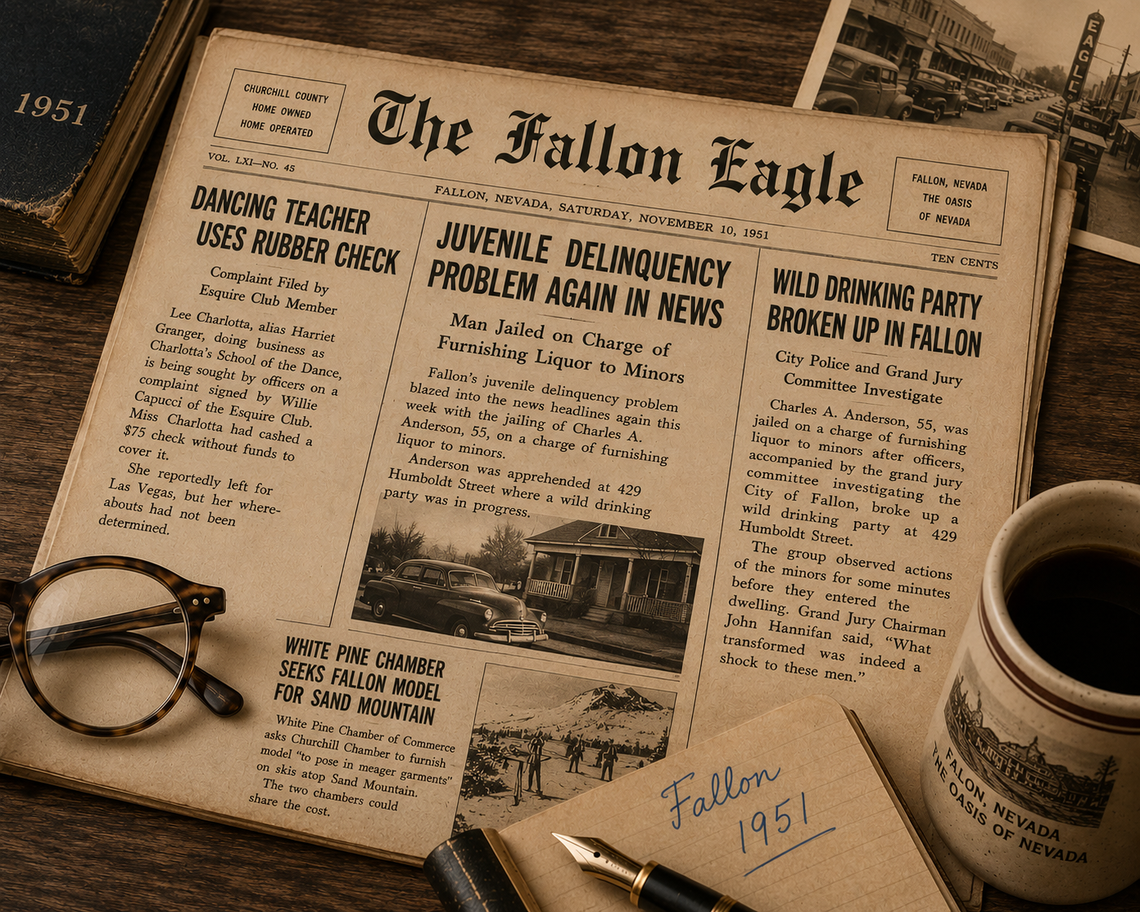
Some incidents might be seen as poking rather small holes in the fortress. A March 24 “Fallon Eagle” headline announced, “Dancing Teacher Uses Rubber Check.” The story was that “Lee Charlotta, alias Harriet Granger, doing business as Charlotta’s School of the Dance, is being sought by officers on a complaint signed by Willie Capucci of the Esquire Club.” Miss Charlotta had cashed a $75 check without funds to cover it. She reportedly left for Las Vegas, but her “whereabouts had not been determined.” One shudders to think that Miss Charlotta had been teaching some of Fallon’s finest young ladies!
That story was followed by one that, again, seems harmless to the contemporary reader, yet the content and tone were quite out of the ordinary, even risqué for the moment. The “Fallon Eagle,” August 11, 1951, printed a letter from the White Pine Chamber of Commerce to the Churchill Chamber of Commerce. The White Pine Chamber was seeking a Fallon model “to pose in meager garments on skis atop Sand Mountain. …We have talked about the sure-fire publicity value of a scantily clad model on Sand Mtn. Could Churchill County furnish a suitable model? …The two chambers could share the cost. … Build and costumes of models are important—in fact, fundamental—as you know.”
Not so easy to dismiss was the growing juvenile delinquency problem. To quote the “Eagle,” November 10, 1951, “Fallon’s juvenile delinquency problem blazed into the news headlines again this week with the jailing of Charles A. Anderson, 55, on a charge of furnishing liquor to minors.”
Anderson was apprehended at 429 Humboldt Street “where a wild drinking party was in progress.” There, city police officers, “accompanied by the grand jury committee investigating the City of Fallon, broke up the party.” Apparently, the grand jury had been in session when the members were informed about the party. Three of them surrounded the house, along with the arresting officers. “The group observed actions of the minors…for some minutes before they entered the dwelling.” Grand Jury Chairman John Hannifan said, “What transformed was indeed a shock to these men.”
Here, the news is, yes, underage drinking, but also the fact that the grand jury intervened as well as city police officers. The situation was, indeed, dire.
As 1951 drew to a close, it must have seemed to the good citizens of Fallon that the sky was falling. The “Fallon Eagle,” December 8, 1951, detailed “The sordid story of the alleged rape” of a 15-year-old girl following a Harmon School Dance.
“The disappearance of the 15-year-old was reported to Gibbs [police officer Ed Gibbs] and Fister [police officer Larry Fister] at 2:30 a.m. Sunday by the girl’s sister who said she had been taken out by two boys at the Harmon dance. A search resulted in the discovery of the young girl in the back seat of a car on Maine St. in a semi-conscious condition attired in scanty clothing.” An exam showed that she’d been raped, and confessions from the young boys were obtained.
The shock of the story is that a rape had taken place in Fallon involving young people. But beneath the ugly surface also lurked the disquieting fact that the rape had taken place in conjunction with a Harmon School Dance, with alcohol involved. A widespread, almost sacred community pride was attached to rural school activities, from Old River to Harmon to St Clair. They were safe; they were family-oriented; they were wholesome. That perception was shaken, literally overnight.
Please send your stories and ideas for stories to [email protected].











Comment
Comments