
 Nancy Chapman
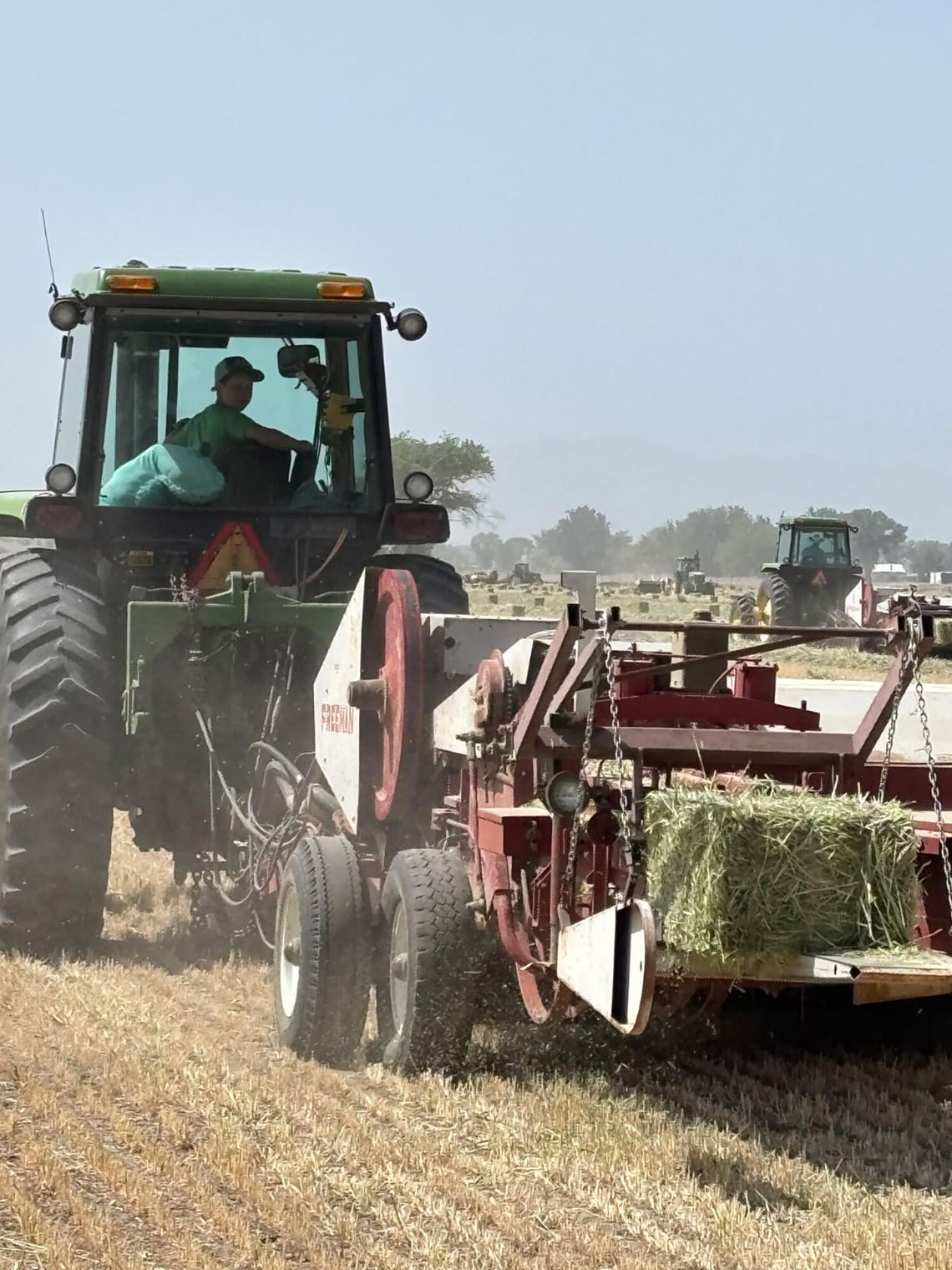
Chris Gomes, a third-generation Fallon farmer, is carrying on his family’s tradition of hay farming, a legacy that started with his grandfather, Constantino, in 1935.
Constantino first arrived in the United States from the Azores Islands off Portugal in 1917, earning citizenship in Yreka, Calif., according to the Sept. 20, 1968, issue of the Fallon Eagle Standard. After several trips between the Azores and the U.S., he settled in Fallon and worked at what is now Dodge Island Ranch, eventually purchasing nearby property. His son, Louis Gomes, was born there, and hay production methods were markedly different at the time.
“The alfalfa was mowed in five-foot swaths, raked into windrows, cross-raked into bunches, and loaded onto wagons by hand,” Chris Gomes recalled. Hay was stacked with a derrick, forming oblong stacks of about 25 to 35 tons each, with two harvests per season, the first after July 4 and the second beginning in September, the Eagle Standard reported.
At age 7, Louis and his family returned to the Azores, where they remained until he was in his twenties. Louis came back to Fallon, arriving by train in Hazen during a snowstorm. “My dad had to wonder what he had done, leaving a tropical island for this,” Chris joked. Louis eventually returned to the ranch on Schurz Highway, now Miller Ranch, and moved his young family closer to Fallon, settling on Allen Road and starting an alfalfa operation on 80 acres.
Louis and his brother Johnny bought neighboring properties, with Louis focusing on hay and Johnny operating Gomes Dairy. Over time, Louis expanded the ranch, acquiring adjacent parcels, which were irrigated and harvested separately.
He was also the first in Fallon to purchase a Harobed, a hay-loading machine named by its inventor, Gordon Grey, after his daughter Deborah. Harobed is Deborah spelled backward.
The new equipment greatly sped up hay stacking, and 90 percent of the hay was shipped to California dairies. After haying season, livestock would graze the property, a tradition that now continues with only sheep. “Sheep don’t bring in weeds like cattle do,” Chris said, guaranteeing clean, weed-free hay.
Chris leased the property from his parents, Louis and Nancy, in 1988 and began modernizing nearly 400 acres, making irrigation, farming, and hay processing more efficient. He grows alfalfa, teff, and a three-grain rotational hay. By removing sand hills, leveling fields, and adjusting ditches and fence lines, the property was consolidated into one large field, simplifying irrigation.
Chris starts the hay season in late May with four cuttings throughout the season, yielding an average of 2,400 tons annually. The hay is swathed, raked, baled, and picked up by Harrow Beds—renamed by New Holland in 1962—and stacked in barns. Alongside his wife, Samantha, and daughter, Jessica, the ranch employs three full-time workers, including Brian, who has been with the ranch for more than 25 years.
The Gomes Ranch has evolved from producing two crops a year, yielding 25 to 35 tons, to producing 2,400 tons annually. Today, 90 percent of the hay is sold within the valley, reflecting the impact of improved equipment and technology on the family’s enduring legacy.








Comment
Comments