
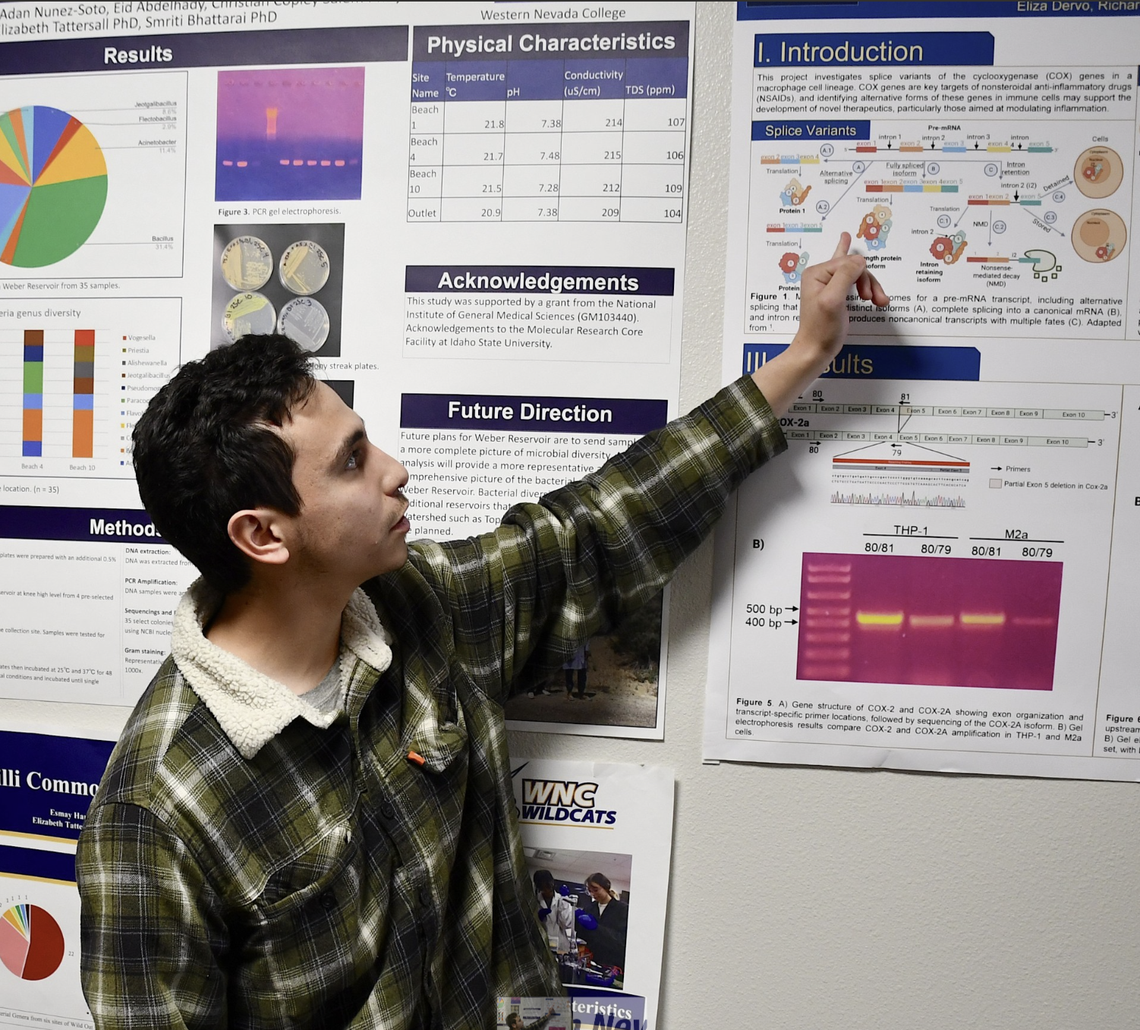
Students at Western Nevada College wrapped up the fall semester by presenting science projects covering topics from environmental microbiology to molecular biology. Through professional poster presentations, they displayed hands-on experience gained in field research, laboratory analysis, and scientific communication.
“Providing our students with research opportunities complements their education and brings concepts and methods into focus,” said WNC President Dr. J. Kyle Dalpe. “We are really fortunate to have so many faculty members who participate in these projects to make these educational experiences for students truly impactful.”
On the Fallon campus, students explored molecular biology through a project titled “Characterization of Cyclooxygenase-1 and Cyclooxygenase-2 mRNA Splice Variants in Human Macrophages.” Research students Eliza Darvo, Richard Gomez, Jilliana Morales, and Christina Robinson worked under the direction of chemistry and biology instructor Dr. Brian Prince, with support from Dr. Gary Evett, professor emeritus.
All lab work was conducted at Fallon, and students took a field trip to the University of Nevada, Reno, to deliver samples for sequencing. Dr. Prince said, “The benefits to students from this experience are incredible. Beyond strengthening their resumes, they learned fundamental molecular biology techniques and discovered how exciting and rewarding research can be.”
Richard Gomez agreed, sharing that the experience exceeded his expectations. Gomez, who completed his Associate of Science degree in Fall 2025 and plans to pursue a bachelor’s degree in general chemistry at UNR, said, “Once I got into it, I realized how much I enjoyed doing science again. I learned I’m much more organized than I thought I was, especially when it comes to ensuring my methods are correct. I’d tell anyone who’s even a little interested in science to give it a try. You never know what you’ll discover about yourself.”
Meanwhile, on the Carson City campus, students tested water from the Bridgeport Reservoir for a microbial study. Participants included Nidal Abdelhady, Maddison Fuggles, Christina Sosa, Jose Salinas Aparicio, Aiden Jacklett, and Tierra Mackay. The project was led by Dr. Elizabeth, professor of biology and chemistry, with support from Dr. Christian Copley Salen and Dr. Smriti Bhattarai.
Dr. Tattersall noted, “This year’s research required students to conduct their work during the academic semester due to a temporary pause in grant funding. While it posed challenges, it also enabled students to integrate research directly into their coursework. They learned essential lab skills, how to maintain a lab notebook, how to prepare and present a poster, and — most importantly — what it’s like to do real research when you don’t know the answer in advance.”
WNC encourages interested students to join a 2026 research group. Applications for future student research opportunities will be available around March. Students who have taken or are currently enrolled in CHEM 121 or BIOL 190 are eligible. WNC expects to offer a three-week research program in early summer 2026.
For more information about research opportunities at WNC, Contact [email protected] or [email protected].








Comment
Comments