
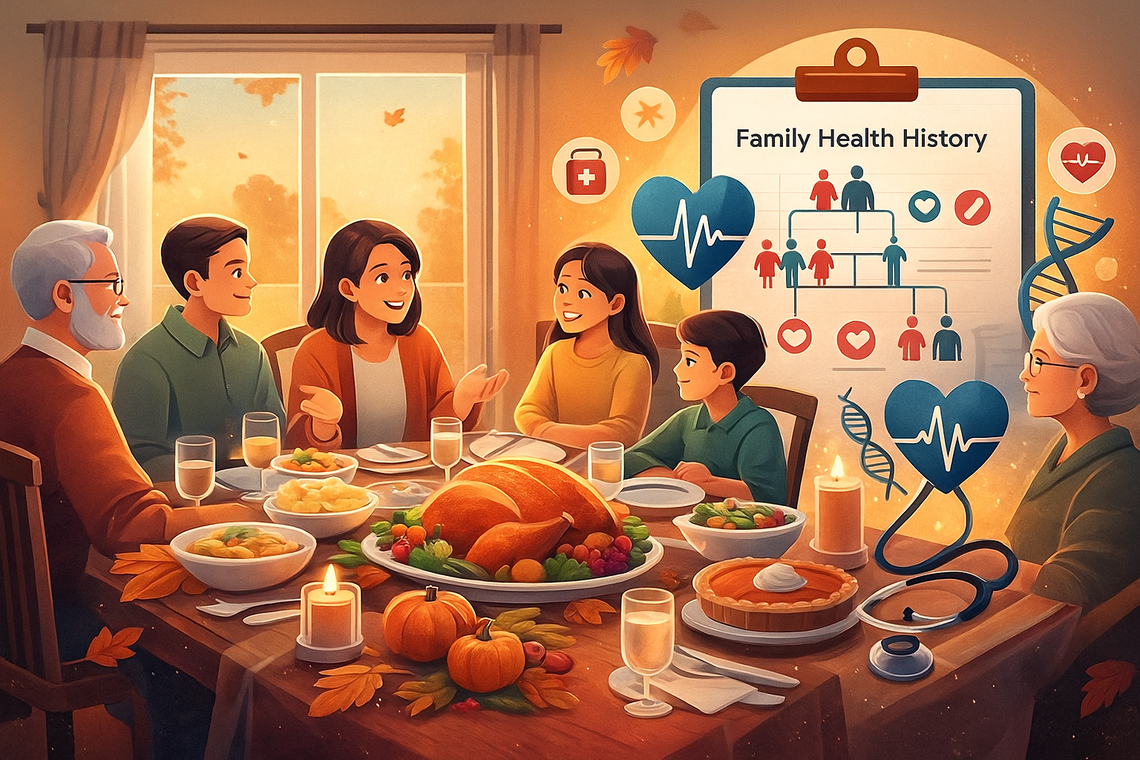
Thanksgiving is the start the season that brings families together to share stories, laughter and a good meal. But there’s another important conversation we should have while we’re gathered around the table: our family health history.
November 28 was National Family Health History Day, a reminder that knowing your family’s medical background could save your life. While it’s not as lighthearted as talking about football or pie recipes, these conversations matter. Many diseases, from heart disease to diabetes to cancer, have genetic links. When we know what runs in our families, we can act earlier, get screened on time and sometimes even prevent serious illness altogether. Taking just a few minutes to discuss your family’s health can provide a roadmap for generations to make better, more informed choices.
As a nurse and a daughter-in-law who has lost three loved ones to cancer—my mother-in-law, father-in-law and sister-in-law—I know how serious the risks are. Their stories inspire me to stay consistent with my own preventative health tests. But even as a healthcare professional, I recently experienced firsthand just how tough it can be to follow my own advice: getting screened.
It took me months to schedule my own colonoscopy to get screened for colorectal cancer (CRC). Between finding an available appointment, arranging time off work and preparing for the procedure, the process did take time and effort. I’m glad I got it done, but it gave me an increased understanding of the importance of making a plan to get screened and looking at all options available.
CRC is the second leading cause of cancer-related deaths in our state, and the Nevada Cancer Coalition forecasts 1,480 new CRC cases this year, with nearly 520 Nevadans expected to die from the disease in 2025 alone. What’s more discouraging is that, despite CRC’s position as a leading cause of cancer deaths, it’s actually one of the most treatable cancers when caught early, boasting a 91 percent five-year survival rate for patients with early-stage, localized CRC. Screenings save lives, but rates remain too low, often because the process can be perceived as inconvenient, uncomfortable or intimidating.
Colonoscopies and stool-based tests are effective screening options. I’m also glad to see innovations in the CRC screening to increase options for patients nationwide. The first FDA-approved blood test for average-risk individuals as a primary screening method for CRC, Shield, is gaining ground. It’s not intended to replace a colonoscopy and is intended for those at average risk, but it offers patients an additional choice that could encourage more people to get screened who might otherwise delay it.
This is more than just a matter of convenience; it’s about access. For people who live far from major medical centers, work multiple jobs or have caregiving duties, some screening options can seem overwhelming. A blood test during a routine doctor's visit has the potential to significantly boost screening rates and save lives, especially in underserved communities.
No matter which test you choose, the most important thing is to get screened. Talk to your doctor, ask about your options and encourage your family members to do the same. This Thanksgiving, while passing food around the table, take a moment to share your family’s health history. It may not be an easy conversation, but it could protect future generations.
Jennifer Belza-Vinuya, BSN RN, resides in the Las Vegas area and is the Director of Nurses for a local healthcare group.










Comment
Comments