
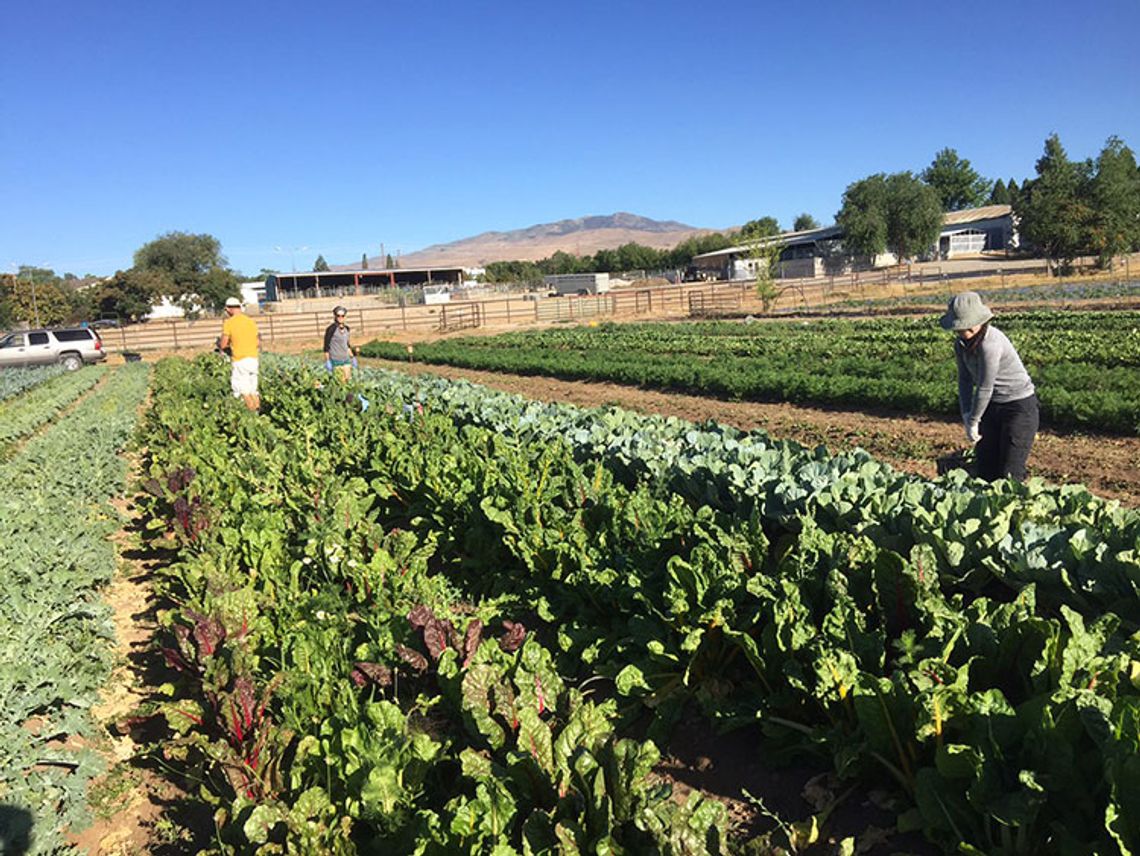
Some aspiring small-scale farmers will have the opportunity to serve a one-year apprenticeship to bolster their abilities to start and run a small-scale operation, thanks to a new Nevada Farm Apprenticeship Program being offered by UNR. The program will be hosted at the University’s Desert Farming Initiative (DFI) in Reno and is pending certification from the Nevada Department of Labor.
“We are really pleased to be able to offer this hands-on, intensive farming apprenticeship program, to help fill in the gaps for those with a degree or some background in agriculture, but not quite enough knowledge or experience to start and run their own small-scale farming business,” said Bill Payne, dean of the University’s College of Agriculture, Biotechnology & Natural Resources. “Our Desert Farming Initiative team has put together an excellent program that I am sure will help establish some new small-scale farms in our state.”
The initial program is being funded by a $256,000 three-year grant from the USDA along with contributions from the college. Applications for the first two apprenticeships will be taken beginning this July. Selections will be made through a competitive process, with apprenticeships beginning in October. Next summer, applications will be taken for another three apprenticeships, with those chosen beginning in October 2024.
The program emphasis is on certified-organic and climate-smart practices for small-scale outdoor farming. Each apprentice will manage a farm incubator space at the DFI, where they will execute a crop and sales plan according to their particular farming interests. They will be allotted approximately one-eighth of an acre for growing field crops, temperature-controlled greenhouse space for starting seedlings, and half of a hoop house for season extension. Incubator spaces will be managed under the DFI’s organic certification and Nevada producer license, as well as rigorous food safety requirements.
“This program will be a springboard for people who are serious about pursuing a career in fruit and vegetable production,” said Jill Moe, DFI’s director. “We’re hearing from farmers market managers, food co-ops, and food hubs that there just isn’t enough local produce to meet regional demand, and we’re creating a pathway to success for a new generation of farmers.”
Moe added that the farm-to-fork and local foods movements have inspired new interest in farming as a career, but that there’s a lot to know before jumping in.
“It’s not just understanding how to grow crops in this climate,” she said. “It’s also creating a business plan, marketing, food safety, legal requirements, accounting, software, collaboration within the food system, and managing people. Our program will cover all that and more.”
The CEDA and the Churchill office of the NSBDC will provide education in business principles and practices. Apprentices who complete the program will understand the regional farming landscape in Nevada, farm-to-market avenues, and topics in food security and food sovereignty. Moe said the program will also prioritize Hispanic, indigenous, and other underserved community members, and is working with tribal communities and the college’s extension unit to incorporate appropriate information and guest instructors.
Team members who are developing and will implement the program include Education Program Coordinator Anna Miller, Farm Production Manager Garrett Menghini, Associate Professor focusing on Agronomy Felipe Barrios Masias, Extension Professor Staci Emm, and the Churchill Enterprise Development Association’s Agricultural Business Advisor Kelli Kelly. “We want to provide practical information and hands-on training for those with some farming knowledge and the burning desire to get into the business,” Moe said. “It’s about equipping them with the knowledge they need to start a successful, sustainable enterprise while contributing to our state’s healthy local food supply and economy. It’s what a land-grant university should be doing, right?”
More information on the apprenticeship program can be found on the following websites:
- University of Nevada, Reno: www.unr.edu
- Desert Farming Initiative: https://naes.unr.edudfi
- Experiment Station: https://naes.unr.edu/default.aspx
- College of Agriculture, Biotechnology & Natural Resources: www.unr.edu/cabnr
- Extension Unit: https://extension.unr.edu/default/aspx
- Apprenticeship Program: https://naes.unr.edu/DFI/apprenticeship.aspx














Comment
Comments