
 Leanna Lehman
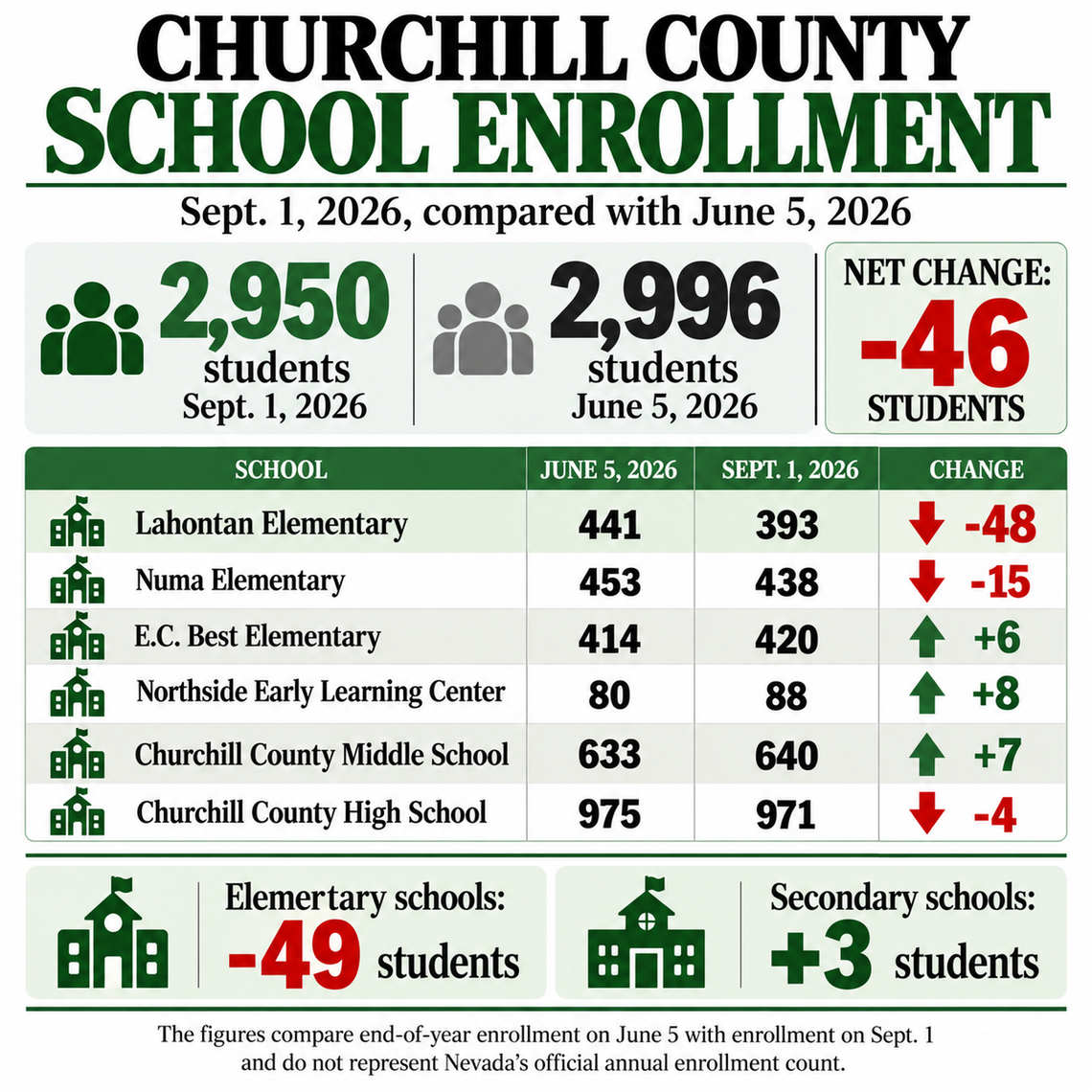
Churchill County School District began the school year with 46 fewer students than it ended with in June, with most of the decline occurring at the elementary level.
Superintendent Blake Cooper discussed the enrollment numbers during the Sept. 15 Churchill County School District Board of Trustees meeting, where trustees also addressed student literacy intervention, early-retirement incentives, a proposed phone system, and negotiated employee agreements.
The district reported enrollment of 2,950 students on Sept. 1, compared with 2,996 on June 5. Elementary enrollment fell by a net 49 students, while secondary enrollment increased by three.
Lahontan Elementary School saw the largest change, dropping from 441 students in June to 393 in September, a decrease of 48. Numa Elementary declined by 15 students, while E.C. Best Elementary gained six and Northside Early Learning Center gained eight. Churchill County Middle School gained seven students, while the high school declined by four.
Cooper cautioned trustees that comparing end-of-year enrollment with the beginning of a new school year does not provide an exact measure of enrollment loss.
“This student enrollment data is a little bit confusing too because you can see from the dates that we’re pulling from September, but also we’re pulling from the end of school year last year,” Cooper said.
What was different this year, he said, was that students who typically return to the district during the summer did not come back at the usual rate.
“So, we typically gain back those students over summer for student enrollment, and we did not this school year,” Cooper said. “And that’s the big difference we see in that 46 number change there.”
Cooper said enrollment had remained relatively stable since Sept. 1, describing the movement as “we lose two, we gain two, we lose two.”
The Sept. 1 report also shows a relatively small incoming kindergarten class of 162 students, compared with 231 first-graders, 208 second-graders, 212 third-graders, 212 fourth-graders, and 226 fifth-graders.
Cooper told trustees in August that enrollment was expected to be down approximately 35 students and that other Nevada superintendents he had spoken with were seeing declines in the same age group.
Enrollment has also declined in the district’s annual count-day figures. The district reported 3,282 students in 2023-24, 3,221 in 2024-25, and 3,098 in 2025-26. The district’s official 2026-27 statewide enrollment count is not yet available; Nevada’s annual enrollment data are reported in early October. For funding purposes, districts report average daily enrollment quarterly.
The numbers matter beyond classroom size.
Under Nevada’s Pupil-Centered Funding Plan, enrollment is a factor in determining how much state funding a school district receives. The board did not discuss the potential funding effects of declining enrollment during the meeting.
Trustees also heard concerns during public comment about spelling work being given to some seventh-grade students. Amber Sanchez questioned the difficulty of words on spelling lists she had seen.
Churchill County Middle School Principal Deana Porretta later explained that the work is part of literacy intervention for students performing below grade level, rather than the spelling curriculum for all seventh-graders.
Porretta said students receiving intervention may be two to four grade levels behind in reading and writing, and instruction is tailored to their individual skill levels. As students master skills, they move into progressively more difficult work.
The board also voted unanimously not to offer early-retirement incentives to classified, licensed, or other eligible employees for the 2026-27 school year.
Trustees spent more than 30 minutes considering proposals to replace the district’s phone system. A motion to begin negotiations with Oasis Online, with an initial proposed cap of $172,930, was ultimately withdrawn as trustees sought clearer comparisons between proposals. No vendor was selected.
The board later unanimously ratified negotiated agreements with district administrators, educators, and classified employees following a closed session.

















Comment
Comments