
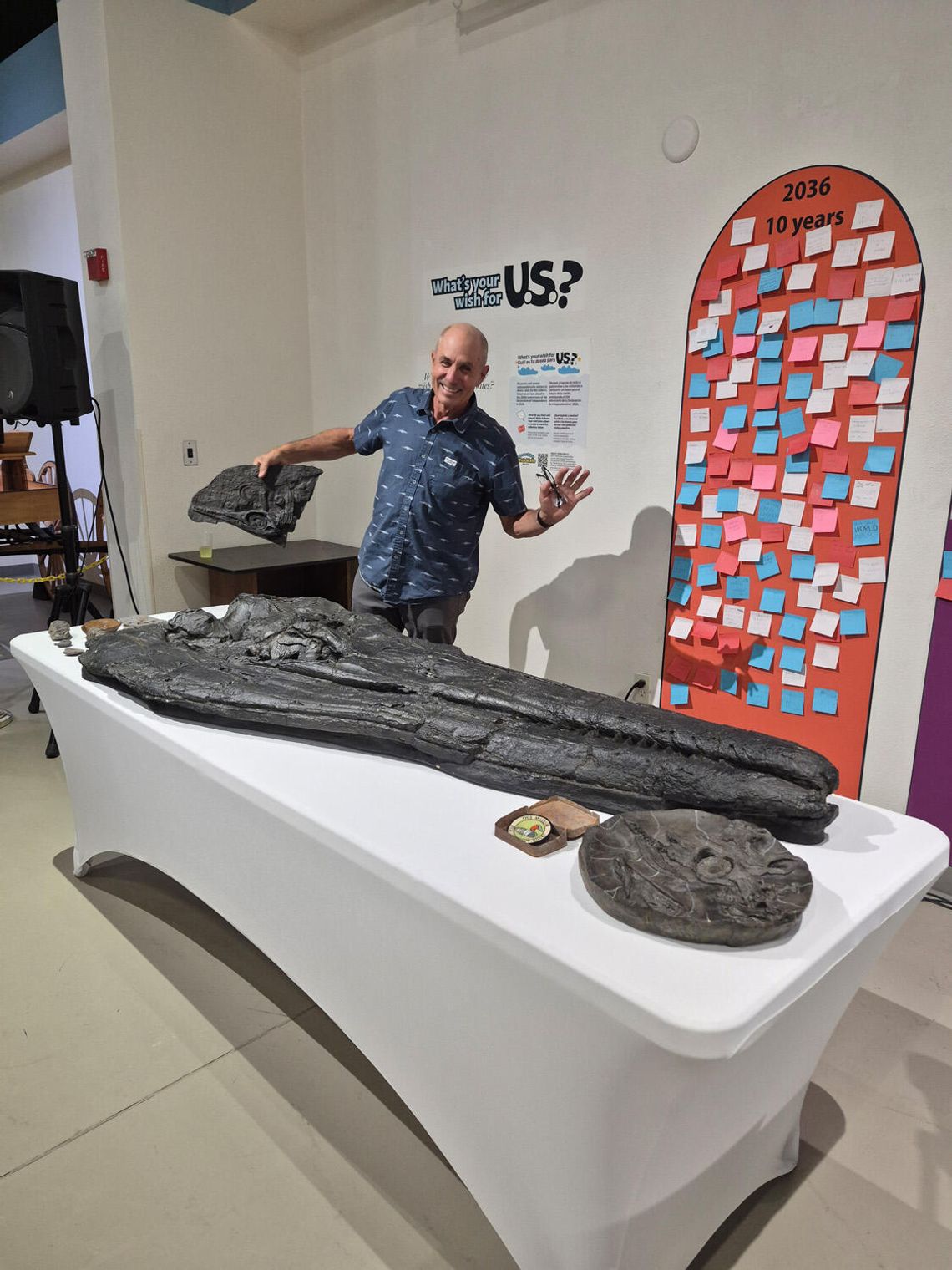
Long before Nevada was known for sagebrush, mountains and desert, enormous marine reptiles swam through an ancient sea that covered much of the region.
Geologist Tom Young brought that distant world to life at the Churchill County Museum during the latest installment of the museum’s fall lecture series, “The Layers of Nevada,” sharing fossils, photographs, and stories from years spent helping paleontologists uncover Nevada’s prehistoric past.
This lecture held a special interest for me. I studied geology in college and grew up in the Black Hills of South Dakota, where fossils and remarkable geology are part of the landscape. Young’s presentation was a reminder that Nevada has an equally fascinating geological story beneath our feet.
Museum Education Curator Laticia Webb introduced Young as a geologist, craft brewer, and co-founder of Great Basin Brewing Company. Young spent nearly three decades in the craft beverage industry, but his geological background and interest in Nevada paleontology eventually led him into the field alongside scientists studying ichthyosaurs.
Ichthyosaurs were marine reptiles, not dinosaurs, that lived millions of years ago. Young explained that Nevada has produced an extraordinary variety of ichthyosaur fossils, including specimens from Berlin-Ichthyosaur State Park and other remote areas of the state. Some were giants. Young described one Nevada specimen estimated at about 55 feet long and discussed ongoing research into even larger animals.
Young’s connection to the creatures began in an unusual place — a brewery.
When Great Basin Brewing Company was getting started, Young and others were choosing names for their beers. One became an India pale ale named for Nevada’s state fossil. Because customers struggled to pronounce “ichthyosaur,” the beer eventually became known simply as “Icky.”
Years later, the beer helped connect Young with paleontologists working in Nevada. He recalled meeting scientists who recognized the connection between the brewery and ichthyosaurs. That encounter led Young into the field, where his geological training and willingness to tackle the physical work of fossil excavation proved useful.
The work is not easy.
Young described traveling hours over dirt roads, camping in remote country, and hiking several miles while gaining about 2,000 feet in elevation, all while carrying equipment needed for an excavation. Once a fossil is located, removing it can involve digging through solid rock, protecting the specimen with plaster jackets, and figuring out how to transport the fossil and surrounding rock out of rugged terrain.
In some locations, Young said, helicopters are the only practical way to remove the fossils. The specimens are then taken to laboratories, where technicians painstakingly separate rock from bone using small tools. One specimen Young discussed took about two years to prepare after it reached the laboratory.
The fossils tell the story of a Nevada almost impossible to picture today.
Young explained that rocks now exposed in Nevada preserve evidence of a time when the region lay beneath an ocean, and marine reptiles inhabited waters where desert ranges stand today. Finding their remains requires knowing where to look. Paleontologists use geological maps to identify sedimentary formations of the appropriate age and areas where fossils have previously been found.
Young brought fossil samples and reproductions to the museum, giving audience members an opportunity to see up close some of the evidence left behind by Nevada’s ancient inhabitants.
For all that scientists have learned from Nevada’s rocks, Young made clear that the story is far from finished. New discoveries can change what researchers thought they understood about the animals that inhabited the ancient sea.
“Every time you go out there, you find something new,” Young said. “I thought we had it figured out. So that’s the fun of it.”






Comment
Comments