 Leanna Lehman
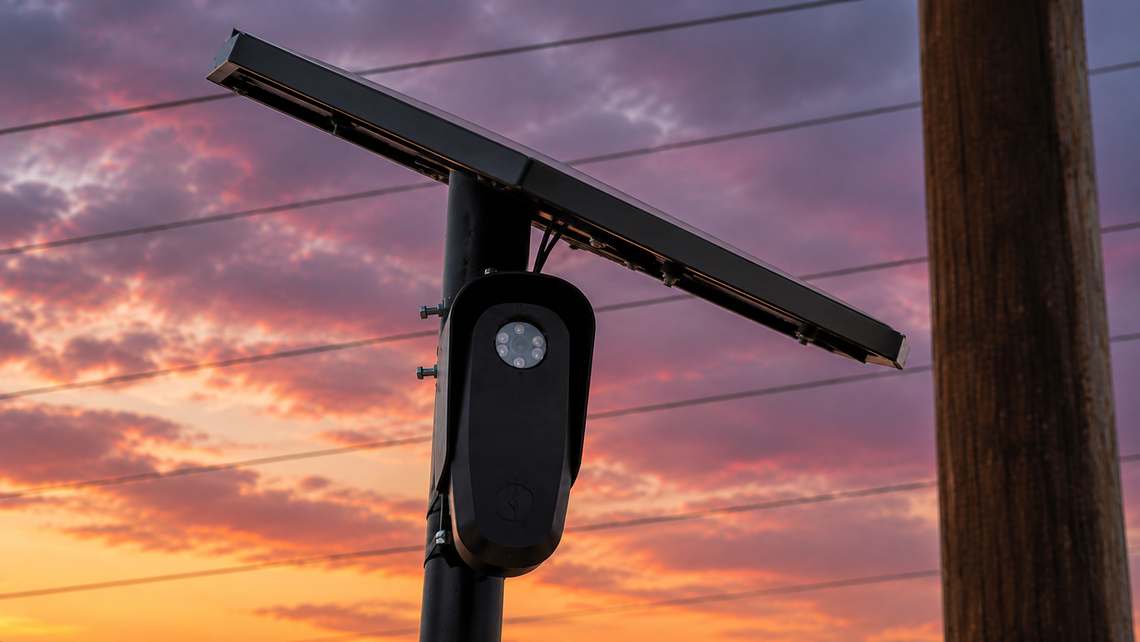
The Churchill County Sheriff’s Office plans to expand its use of automated license plate readers along highways entering the county as the technology draws questions locally and nationwide over privacy, accuracy, and law enforcement access to information.
Automated license plate readers, or LPRs, are camera systems that photograph passing vehicles and use software to read and record license plate numbers. In recent months, Flock Safety, a manufacturer of LPR systems, has faced criticism following documented plate-reading errors, questions over data sharing, and cases involving misuse by law enforcement. Those concerns have also left Churchill County residents with questions about the local use of LPRs.
The Sheriff’s Office, or CCSO, does not use Flock cameras but currently operates one portable Motorola LPR and is working to add two more, with the eventual goal of placing cameras along the four primary routes into Fallon.
While the cameras capture license plate information, CCSO Capt. Matt Timmons clarified that they do not use facial recognition, connect to Bluetooth devices, collect cellphone information, or automatically identify the registered owner.
Capt. Brad Kufalk explained LPRs in simple terms: “They only see what you see driving down the road.”
“When a car does drive by the camera, all it provides us is a photograph of the car,” Timmons said. “It gives us the license plate information, just the numbers, and the make and model. It doesn’t give us anything about who the owner is.”
The readers do capture the plates of vehicles passing them, but deputies are not alerted to every vehicle. The system instead looks for plates entered into databases identifying vehicles law enforcement has a reason to locate.
Information from the National Crime Information Center includes stolen vehicles, Amber and Silver alerts, and certain other law enforcement entries. However, being alerted to that information is only the first part of the process. “We still have to get probable cause … and to have reasonable suspicion to pull that car over,” Timmons explained.
Drug trafficking is also part of the reason law enforcement officials have advocated for LPRs. During a North Central Nevada Narcotic Task Force presentation earlier this year, Sgt. Meghan Madrigan said traffickers are increasingly using rural highways to avoid the greater law enforcement presence and LPR coverage found along interstate corridors. “They’re taking these more rural, desolate roads because they’re not being tracked as much,” she said.
Task Force Officer Garrett Long described a Washoe County traffic stop on Interstate 80 last year that resulted in the seizure of approximately 65 pounds of methamphetamine. Long said the driver told investigators he had transported similar loads on U.S. 50 numerous times because rural agencies lacked the same technology and resources. Long quoted the driver as saying, “If it’s rural and doesn’t have the technology, that’s our route.”
While privacy is among the chief concerns surrounding LPR technology, federal courts have distinguished between information exposed to public view and areas where a reasonable expectation of privacy exists. In United States v. Diaz-Castaneda, the 9th U.S. Circuit Court of Appeals, whose jurisdiction includes Nevada, ruled that checking a license plate does not constitute a search under the Fourth Amendment. The court noted that license plates are displayed on the exterior of vehicles, are plainly visible to passersby, and are intended to convey identifying information about the vehicle.
Sheriff Lee Orozco made a similar distinction between what can be observed from a public roadway and areas where an expectation of privacy may exist. “There’s already case law that establishes that there’s no reasonable expectation of privacy in a public area,” Orozco said. “Now, if we were to be pointing those cameras at, say, a residence or something like that, then there would be that expectation of privacy.”
Orozco said the department ultimately wants readers positioned along U.S. 50 east and west and U.S. 95 north and south. The goal is to give deputies advance notice of vehicles they have a legitimate law enforcement reason to locate, including stolen vehicles and those associated with Amber and Silver alerts, before they reach more populated areas.
“Our intention is not to see who’s running around town,” Orozco said. “It is to be on the outskirts and see who’s coming into our town.”
He pointed to a 2011 pursuit that entered Fallon and ended in a shootout near Jack in the Box as an example of the type of incident in which warning could allow deputies to attempt to stop a vehicle before it reaches town.
Accuracy is another concern surrounding LPR technology. Orozco acknowledged that automated readers can misread plates and said CCSO requires independent verification through dispatch, which confirms with the Nevada Department of Motor Vehicles before deputies act on an alert. “Even though there’s a hit, they have to separately confirm that it’s correct,” Orozco said.
Use of the system is audited weekly. Timmons said anyone entering information into the hot list or searching information collected by the readers must have a case number or otherwise be able to justify the law enforcement purpose for doing so.
The department has already used the reader in several investigations. In July, Orozco said the U.S. Marshals Service contacted CCSO regarding a felony fugitive wanted in Idaho and Humboldt County on violent charges. The vehicle registered a hit on the local reader, and law enforcement was able to locate the suspect and make an arrest with the Marshals Service.
In another case, an outside agency searching for a missing person contacted CCSO. While the system could not show that the person had been in Churchill County, it could confirm the person’s vehicle had been recorded in the area.
Access to CCSO’s system is restricted, according to Timmons. If Motorola technicians, who must have NCIC clearance, need to troubleshoot the equipment, the Sheriff’s Office must temporarily grant access, which is terminated after the work is completed. He added that commercial users of license plate reader technology, such as repossession companies, do not have access to CCSO’s law enforcement information.
Each additional Motorola reader is expected to cost approximately $14,000, plus annual service fees. Timmons said CCSO is working with Motorola on a quote for two more and hopes to have them operating this year. The equipment is currently being funded through the department’s regular county budget.
For Orozco, the cameras provide another set of eyes along highways where deputies cannot always be present.
“It’s just a force multiplier for us,” he said. “We can’t be everywhere.”





Comment
Comments