
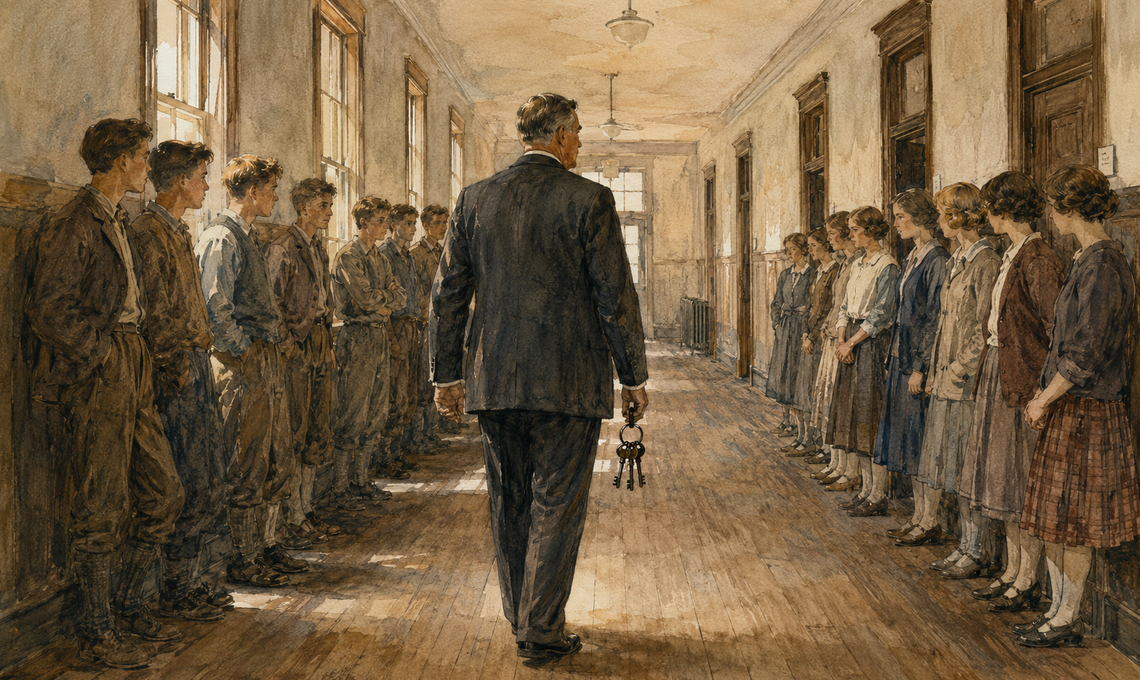
The name George McCracken, principal of Churchill County High School during the 1920s and 1930s, weaves consistently through the oral histories provided by students who attended there at the time. Was the principal, indeed, a pal? Well, yes and no. McCracken was viewed with fear and trembling, mixed with admiration and respect, even love. I’ll let the students speak for themselves.
Harold Rogers (attending in the 1930s): He was “a fabulous instructor.” Rogers brought up a theme that is present in almost every student memory of McCracken—his separation of boys and girls at every school event. “The girls were on the north side and the boys were on the south side and they did not mix…” Even at the dances, “the boys and gals, when they were dancing, kept plenty of daylight between them.”
Ivy Ringstrom (attending in the 1930s): There was no “hanky-panky,” even in the hallways.
Agnes Severs (attending in the 1920s): When asked about McCracken’s strictness: “Oh, ho ho! I’ll say.”
Della Renfro Oats (attending in the 1930s): About the dress code, “there was no extra skin showing, I assure you. I can remember one time a girl came in — they had these three-quarter socks, they were quite colorful and otherwise we wore long [socks], I wore rayon. Now I think some of the ones that could afford them had silk socks, but this girl came to school and her skirt probably let one inch of bare skin between the skirt and these three-quarter socks showing. She was sent home to properly dress. … They elected him to really turn the school over and he did.”
Allen Spoon (attending in the 1930s): “He was strict as all get out.”
John Marean (attending in the 1920s): “He did it [separating the sexes] very intelligently. He knew he could not be everywhere at all times, and he didn't really want to catch anybody guilty of communicating between the sexes in spare time, so he always jingled his keys as he walked down the hall. You knew Mac was coming, and so you certainly never left yourself in a compromising situation.”
Frank Woodliff (attending in the 1920s): “We [his band] used to play for the high school dances. …We played for the high school dances in that area and of course we played on the stage. The old high school has a stage and we played there and we were supposed to quit at midnight and if you knew Mr. McCracken, you quit at midnight. And fact of the matter is that at five minutes to twelve you'd find the lights blinking and at five minutes to twelve we'd go into our last tune, ‘Goodnight Sweetheart’ — or something like that, you know, and at midnight sharp it was over.”
McCracken’s disciplined and ethical nature played into the 1924 “Football Scandal.” That year, CCHS had an exceptionally good football team, led by a charmed quarterback, and they were on their way to a state championship. The quarterback was challenged by officials from Yerington who claimed that he was too old (21) to be legally playing. McCracken investigated and discovered that the talented quarterback really was 21 years old and therefore ineligible. Rather than concealing the evidence, McCracken withdrew the entire team for the rest of the season. The town went into shock. However, McCracken didn’t. He told the local paper that the young man, despite the dishonesty, was an honorable student. But rules were rules, even when they weren’t his.
What comes across in the memories of McCracken is his duty as disciplinarian, yes, but also his role as good shepherd. His two sides — the rule-keeper and the guide — were summed up by Earl Nygren (1930s) and Virgil Getto (1930s) in similar ways. Nygren commented that he didn’t think there was any student that went to school with Mr. McCracken who did not look back and, in one way or another, “thank him for the directions that he headed them in.” Getto put it this way: “I was student body president, and I was also junior class president, and George McCracken was our principal. He was very strict, very. None of the kids liked him until they got out of school, and then I have this wonderful respect for this man that was, he was just like the Rock of Gibraltar, and I don't know how he did all the things that he did.”
McCracken’s personal life remains somewhat elusive. All I have discovered is what Della Renfro Oats said about it in her oral history: “He wasn't married at that time. We had a Home Ec. teacher named Miss Olive Colpus and he was socially connected with her and after a number of years — he had a mother that he lived with and was caring for and so I don't think he married Olive Colpus until she [his mother] died.”
I hope they then danced, cheek to cheek.
Please send your stories and ideas for stories to [email protected].
















Comment
Comments