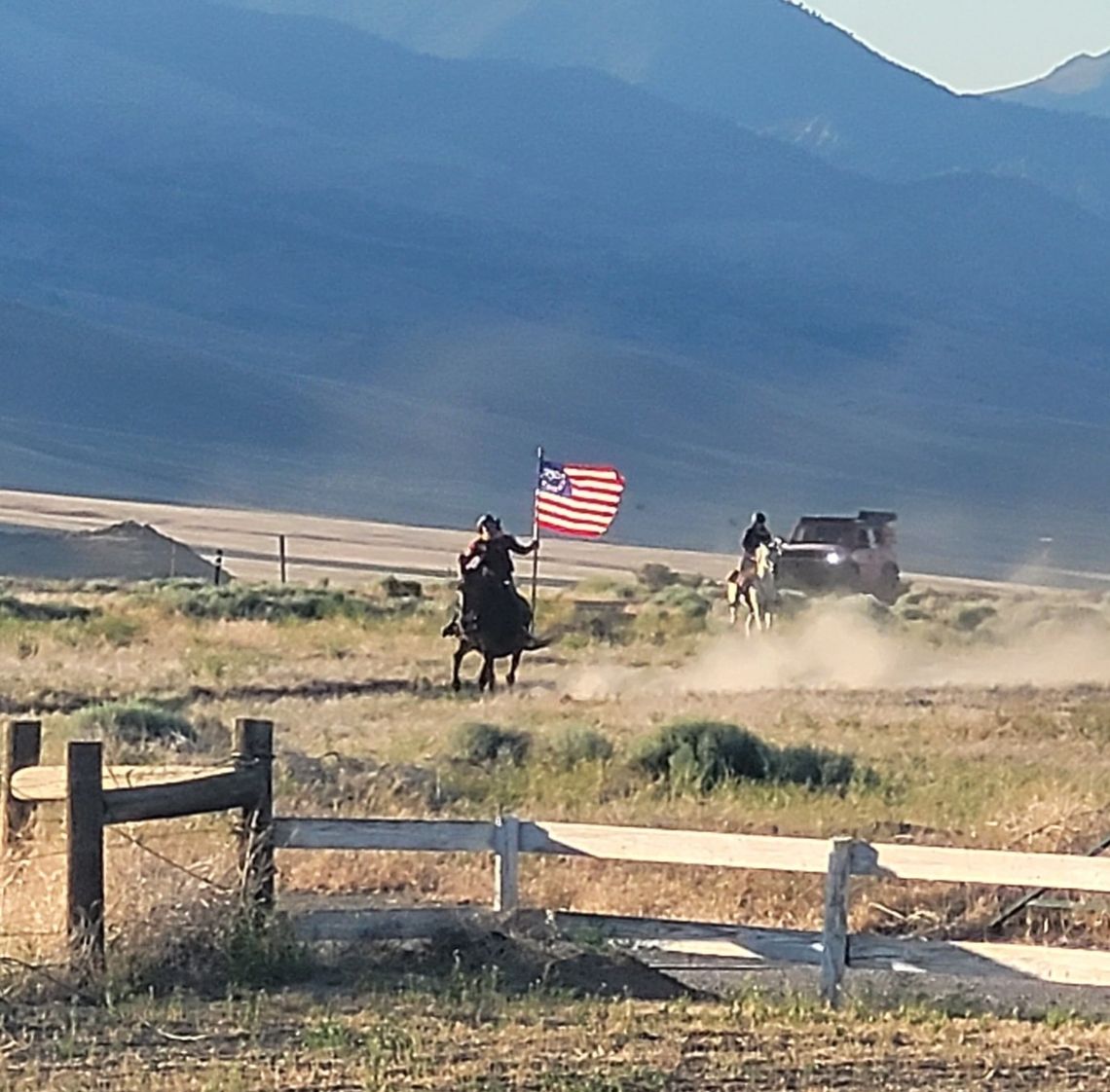
The pounding of hooves echoed across the Nevada desert Tuesday evening as the annual Pony Express Re-Ride arrived at historic Cold Springs Station, where local riders, volunteers, and spectators gathered to welcome one of the American West's most enduring traditions back to Churchill County.
The relay reached Cold Springs Station at about 7 p.m. June 23 with Fallon resident Jillian Wolgast carrying an America 250 commemorative flag. Close behind, another rider carried the Pony Express mochila — the leather mail pouch that became the symbol of the nation's first fast mail service.
The stop at Cold Springs carried special significance. Established in 1860 along the Central Overland Route, Cold Springs Station was one of the original Pony Express stations and remains an important waypoint during the annual re-ride.
Each June, the National Pony Express Association organizes the relay across the original Pony Express route between St. Joseph, Missouri, and Sacramento, California. The nearly 2,000-mile journey crosses eight states as hundreds of volunteer riders carry the mochila continuously, day and night, preserving one of the nation's best-known frontier traditions.
Churchill County remains an important part of that tradition.
Wolgast served as Ride Captain for the section between Cold Springs and Sand Springs, coordinating riders while also riding several relay segments herself. Numerous local riders joined the effort as the mochila continued west across Nevada.
Among them was Hillary Bates of Kingston, who rode Comet while carrying the mochila through Churchill County. The mochila is handed from horse to horse every few miles without removing it from the saddle, just as it was during the original Pony Express.
Keeping the relay moving safely requires more than riders.
Volunteer amateur radio operators accompany the relay through remote stretches of Nevada where cellular service is unavailable. They provide communications between riders and support crews and stand ready to summon emergency assistance if needed.
Volunteers from Fallon and Silver Springs followed riders for approximately five hours after the relay departed Cold Springs Station, helping maintain communications and monitor rider safety through some of the state's most isolated country.
As daylight faded into darkness, riders continued across the high desert using headlamps while the mochila moved steadily west. The relay never stops, with fresh riders taking over every few miles until the mail reaches California.
This year's re-ride traveled west from Missouri to California. The National Pony Express Association alternates the direction each year, meaning the 2027 relay will travel eastbound.
For those gathered at Cold Springs Station, Tuesday's event was more than a historical reenactment. It was a reminder that Churchill County remains part of a living tradition, one sustained each year by volunteers dedicated to preserving an important chapter of American history.
The Pony Express at a Glance
First Ride: April 3, 1860
Last Ride: October 1861, after completion of the transcontinental telegraph
Original Route: St. Joseph, Missouri, to Sacramento, California
Distance: Approximately 1,966 miles
States Crossed: Missouri, Kansas, Nebraska, Colorado, Wyoming, Utah, Nevada, and California
Mail Delivery Time: About 10 days coast to coast
The Mochila: The leather mail pouch is placed over the saddle and transferred from horse to horse without being removed, a tradition still followed during today's annual re-ride.
The Re-Ride: Organized each June by the National Pony Express Association, the event uses hundreds of volunteer riders who relay the mochila continuously across the historic route.
Churchill County Connection: Cold Springs Station was one of the original Pony Express stations established in 1860 and continues to serve as a stop during the annual re-ride.







Comment
Comments