
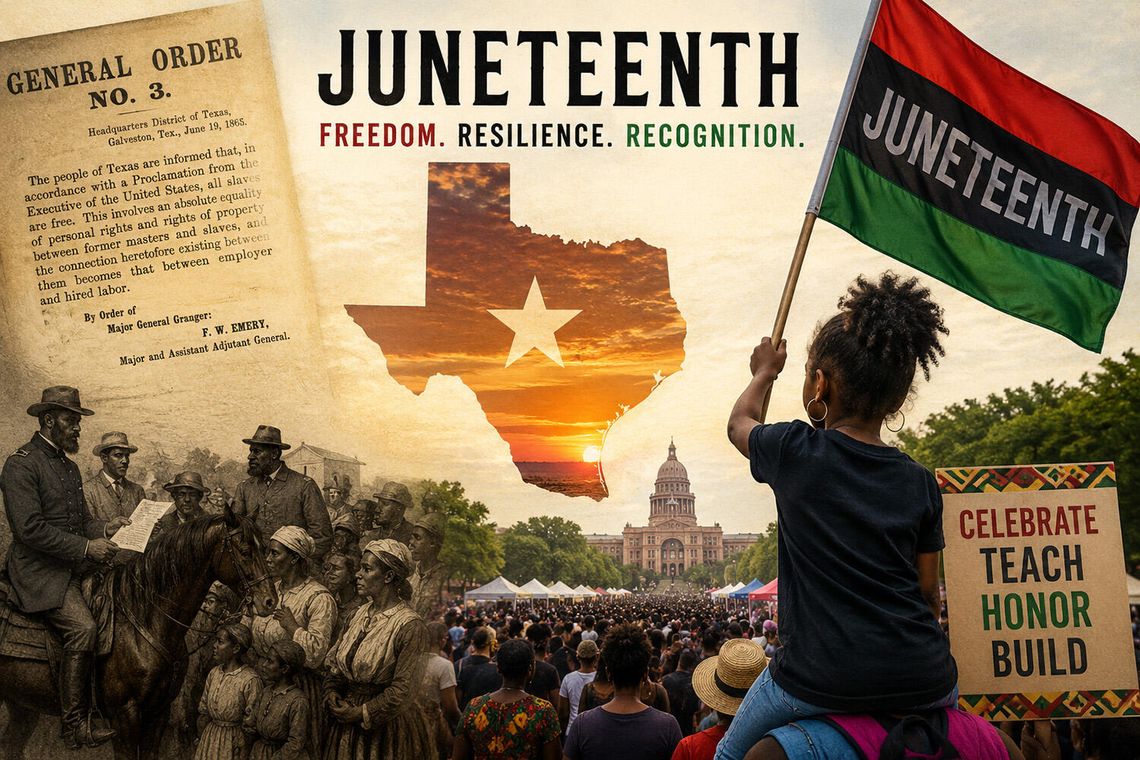
More than two years after President Abraham Lincoln declared enslaved people free, thousands of Black Texans were still waiting to hear the news.
On June 19, 1865, Union soldiers arrived in Galveston, Texas, and announced that enslaved people were free. The moment gave rise to the holiday now known as Juneteenth, one of the most significant dates in American history and a reminder that freedom was not experienced equally or immediately across the nation.
Juneteenth takes its name from a combination of “June” and “nineteenth,” the date Union Maj. Gen. Gordon Granger issued General Order No. 3 in Galveston. The order informed Texans that “all slaves are free,” formally enforcing the Emancipation Proclamation in the state.
Although Lincoln issued the Emancipation Proclamation on Jan. 1, 1863, the order applied only to Confederate-held territories and depended on Union military enforcement to become effective. Because of its distance from major battlefields and the limited presence of Union troops, Texas became a refuge for slaveholders during the Civil War. As a result, slavery continued largely uninterrupted there even after the proclamation. By the end of the war, Texas still held one of the largest populations of enslaved people in the Confederacy.
The delay between the Emancipation Proclamation and Juneteenth is central to the holiday’s meaning. Enslaved Texans waited more than two and a half years after the proclamation before learning they were legally free. Historians note that emancipation was not a single event, but a process that unfolded differently from place to place, often depending on the arrival of federal troops and the willingness of local authorities to comply.
The years that followed were difficult. Although freedom had been declared, formerly enslaved people faced enormous obstacles during Reconstruction, including violence, discrimination, economic hardship, and efforts to limit newly gained rights. Even so, Black Texans began organizing annual Juneteenth celebrations as early as 1866, preserving the memory of emancipation for future generations.
While Juneteenth had long been celebrated within Black communities, broader national recognition accelerated during the 21st century.
More than 150 years after the events in Galveston, one Texas woman helped bring that history to the entire nation.
Opal Lee, a retired teacher and community activist from Fort Worth, spent decades promoting Juneteenth and educating Americans about its significance. Known today as the “Grandmother of Juneteenth,” Lee launched a national campaign to make June 19 a federal holiday.
In 2016, at age 89, Lee began a symbolic walk toward Washington, D.C. She walked in 2.5-mile increments to represent the two and a half years that passed before enslaved Texans learned they were free. Her efforts eventually included a petition signed by more than 1.5 million supporters urging Congress to recognize the holiday.
Lee’s persistence paid off on June 17, 2021, when President Joe Biden signed the Juneteenth National Independence Day Act, making Juneteenth the first new federal holiday established since Martin Luther King Jr. Day in 1983. Lee stood beside Biden during the signing ceremony.
Today, Juneteenth is observed across the country with parades, community festivals, educational programs, historical reenactments, concerts, family reunions, prayer services, public readings of General Order No. 3, and celebrations of African American culture and history. Many communities also host voter-registration drives, scholarship programs, and civic events focused on education and public service.
In Nevada and across the nation, Juneteenth celebrations now include community gatherings, educational programs, cultural events, and opportunities to reflect on the nation’s ongoing pursuit of equality.
For many Americans, Juneteenth is both a celebration and a history lesson. It commemorates the day freedom finally reached Texas, honors those who endured slavery, and recognizes the generations who worked to ensure that their story would not be forgotten.


















Comment
Comments