
My dad was a World War II veteran, and when I was growing up, he always called Nov. 11 Armistice Day.
The holiday had officially been renamed Veterans Day in 1954, before I was born, but Dad never stopped calling it Armistice Day.
He explained that an armistice meant laying down military arms, a truce between opposing forces. But he also made sure I understood that a truce didn't necessarily mean the war was over.
Dad knew something about war. Morris Gene Hallock enlisted in the Navy in 1943 at just 17 years old. A signalman third class, he joined the newly commissioned destroyer USS Putnam in San Francisco in October 1944. He sailed into the Pacific aboard the Putnam, serving during the battles of Iwo Jima and Okinawa and through Japan's surrender. By Christmas 1945, he and the ship were back in San Diego.
After the war, Dad came home and became a newspaper publisher. He founded the Tri-State Livestock News and published several other newspapers in western South Dakota. Newspapering ran in the family, although I didn't follow him into the business until much later in life.
I grew up knowing Dad had been to war, but I don't think I fully appreciated how much history was behind the words he used. Armistice Day was one of those things I accepted without giving it much thought. After all, that's what Dad called it.
What I didn't know was how many armistices were signed during World War I, or that the famous agreement of Nov. 11, 1918, had to be extended three times before the peace treaty was signed.
Most of us learned that World War I ended at the 11th hour of the 11th day of the 11th month in 1918. It is one of those dates that sticks with you, even if you don't remember much else from history class.
But the fighting didn't stop everywhere at once.
Bulgaria signed an armistice in September 1918. The Ottoman Empire followed in October, and Austria-Hungary signed its agreement in early November. Germany was the last of the major Central Powers to agree to stop fighting, with its armistice taking effect at 11 a.m. Nov. 11.
And here's something I really didn't know. That famous Nov. 11 armistice had an expiration date.
Just 36 days.
The countries involved had agreed to stop fighting, but they hadn't agreed on how to make peace. The original agreement was extended in December 1918, again in January 1919, and once more in February. The final extension had no fixed expiration date, although it could be terminated with three days' notice, while negotiations dragged on.
It wasn't until June 28, 1919, more than seven months after the guns fell silent, that the Treaty of Versailles was signed. Even then, the treaty didn't officially take effect until Jan. 10, 1920, for the countries that ratified it.
And even that treaty didn't settle everything. The years that followed brought political upheaval, economic hardship, and eventually another world war.
The ongoing conflict involving the United States and Iran has made me think about Dad's explanation. We hear about ceasefires, truces, negotiations, and peace agreements, sometimes as though they mean the same thing. But stopping the fighting and making peace are two very different things.
I wonder how many people today know what an armistice actually means. Or how many know that the original Armistice Day commemorated the end of fighting in a war that was supposed to end all wars.
In 1954, after another world war and the Korean War, Congress changed the holiday's name to Veterans Day to honor Americans who had served in all wars, not just World War I.
That was a fitting change. The men and women who served in World War II, Korea, Vietnam, and the conflicts that followed deserve to be remembered alongside those who fought in the trenches of France.
But I understand why Dad never changed what he called the day.
He had seen war from the deck of a Navy destroyer. He had been part of a generation that knew firsthand what it meant when the fighting finally stopped.
I don't know whether he ever thought about those three extensions of the 1918 armistice. We never talked about that part of the history.
But he made sure I understood something that has stayed with me for a lifetime.
Laying down your arms doesn't necessarily mean the war is over.
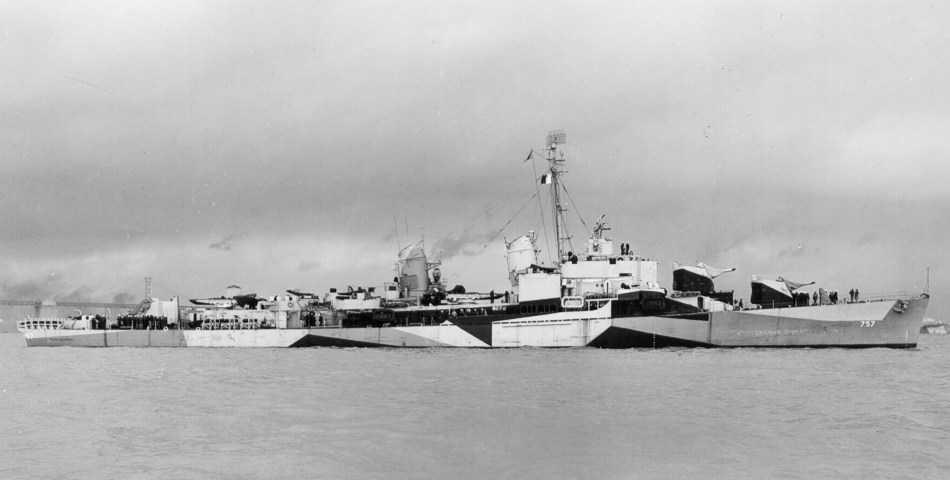
The USS Putnam (DD-757) was photographed off San Francisco on Dec. 29, 1944, shortly before departing for the Pacific. Morris Gene Hallock served aboard the destroyer as a signalman third class during World War II, including operations at Iwo Jima and Okinawa. U.S. Navy photo.






Comment
Comments