 Leanna Lehman
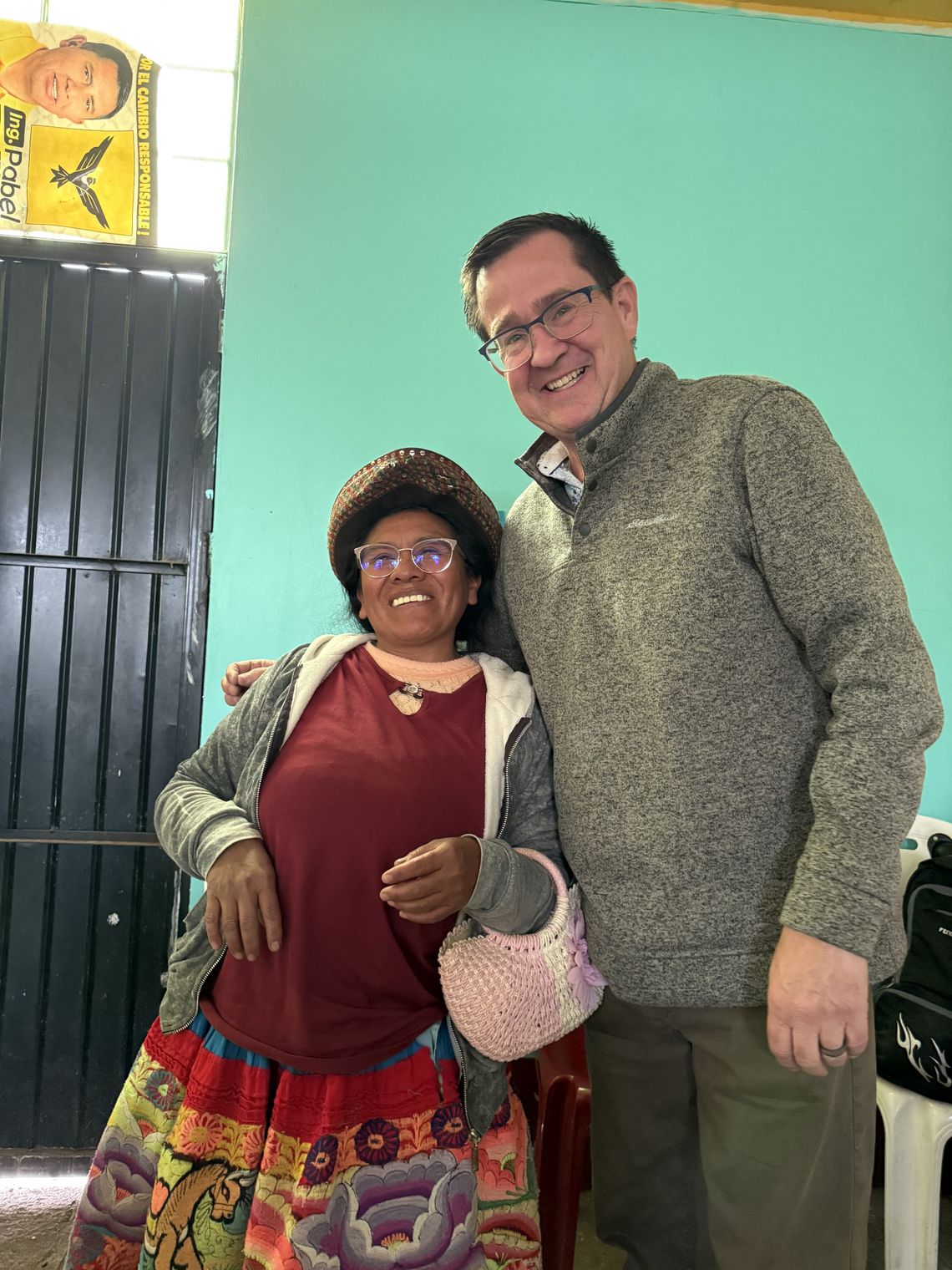
An elderly woman in a remote Peruvian village couldn't stop giggling. In her 80s, she had just received a pair of eyeglasses and was seeing things clearly for perhaps the first time in decades.
For Fallon optometrist and Nevada Assemblyman Dr. Gregory Koenig, seeing that woman's reaction was worth the months of preparation and the long days spent working in remote villages.
"The coolest parts were just seeing people being able to see for the first time in their life," Koenig said.
Koenig and his wife, Terra, recently returned from a medical mission to the Andean highlands of Peru, joining a 12-member team providing medical and dental care, eyeglasses, food, and clean drinking water.
The Oct. 16-23 mission was organized through Ethnos Movement International (EMI-USA) and Asociación VIDAS, a faith-based ministry in Peru. Volunteers came from Fallon, Henderson, and the Salt Lake City area.
Former Nevada Assemblyman Thaddeus "Toby" Yurek III invited Koenig to provide eye care. It was Koenig's first medical mission, and practicing optometry in the mountains of Peru would be considerably different from seeing patients in Fallon.
The team traveled by bus to Colcapampa, Pampamarca, and Quinua, communities in the Andes at elevations exceeding 11,000 feet. The first two were approximately 3½ hours from Ayacucho, where the volunteers stayed, while Quinua was about 1½ hours away. They spent one day in each community, often leaving before sunrise and returning late in the evening, with little time for meals or breaks.
Koenig explained that most homes had dirt floors and no running water. Residents collected rainwater or relied on rivers contaminated with parasites. Boiling water didn't guarantee purification, and firewood was an expense many families struggled to afford.
Volunteers spent several days purchasing supplies, assembling food packages, and preparing 250 household water filtration systems using buckets purchased locally and drilled to accommodate filters. Each system provided a household with a way to obtain drinking water without boiling it first.
Getting more than 2,000 pairs of donated eyeglasses from Nevada to Peru presented another challenge. Koenig's Fallon office staff spent months cleaning and cataloging the glasses, assigning each pair a number corresponding to its prescription on a spreadsheet. Koenig expressed gratitude for their work. Fallon residents and fellow optometrists contributed the glasses, which required three additional large suitcases, each packed to the luggage weight limit.
Once in Peru, Koenig discovered his equipment was more limited than anticipated. His new handheld vision screener required an internet connection, which was unavailable in the villages.
Fellow volunteer Tony came to the rescue with a Starlink satellite system, its cable stretched across a cow pasture.
"We had to have someone watch and make sure the cows didn't come and knock over our Starlink," Koenig said.
Without his usual equipment, finding the right prescription often came down to a hope and a prayer. Fortunately, for Koenig, it seemed as if both were heard, with many results nothing short of remarkable.
Because the examination areas were too bright, Koenig used blankets to create a darkened space, allowing patients' pupils to enlarge naturally for a more accurate distance reading. He improvised with blankets, much like children making tents in their living rooms. There, he examined patients while Terra retrieved numbered glasses for them to try.
The process was no small feat. Koenig explained that one interpreter translated Quechua into Spanish, and another translated Spanish into English for the American volunteers.
One young boy needed a particularly strong prescription. Koenig was surprised and delighted to find a donated pair that matched almost exactly. A motorcycle delivery driver who could barely make out the largest letter on an eye chart improved to nearly 20/20 vision.
Unfortunately, not everyone could be helped.
Koenig encountered patients with severe cataracts, commonly treated with surgery in the United States. In these communities, treatment could require multiple seven-hour round trips and expenses residents could not afford.
"Some of these people, you know, are pretty much nearly going blind from an easily treatable condition. At least it's easily treatable here in the States," he said.
Dentist Cary Jaques also faced equipment limitations, including an X-ray machine that would not charge, restricting the procedures he could safely perform.
The team served 360 people through 482 consultations: 280 medical, 75 dental, and 127 optometry. Koenig distributed 97 pairs of prescription glasses and 67 pairs of reading glasses, leaving the remaining glasses with villagers. Volunteers also provided 250 household water filters and 110 bags of food.
The workdays were exhausting. On one occasion, rising water at river crossings forced the volunteers to leave early, with 20 to 25 people still waiting for eye care.
Local leaders welcomed the volunteers, sometimes with singing and dancing.
"They were so appreciative for being there. Their leaders would want to introduce us and we were like rock stars," Koenig recalled.
The mission included Christian outreach, with team members sharing their faith. EMI-USA President Todd Wellman said the organization hopes to continue bringing medical professionals to the region.
Koenig hopes to return, perhaps every other year. If another trip comes together, The Fallon Post will invite community members to donate used eyeglasses. Hundreds of donated pairs remained in Peru, where Koenig hopes they may benefit other residents.
Despite their limited resources, Koenig said the villagers appeared happy and welcoming. For him, the experience was a reminder that money isn't a prerequisite for happiness.
"It just makes you realize … how blessed we are here in the States."
For now, he remembers the people whose lives changed with something as simple as a pair of glasses, particularly the elderly woman who couldn't stop smiling.
"It was worth it … just to see the gratitude and the smiles on the people's faces as they got their glasses for the first time beyond description it was it was amazing just made it all worthwhile."

Comment
Comments