
 Michon Mackedon
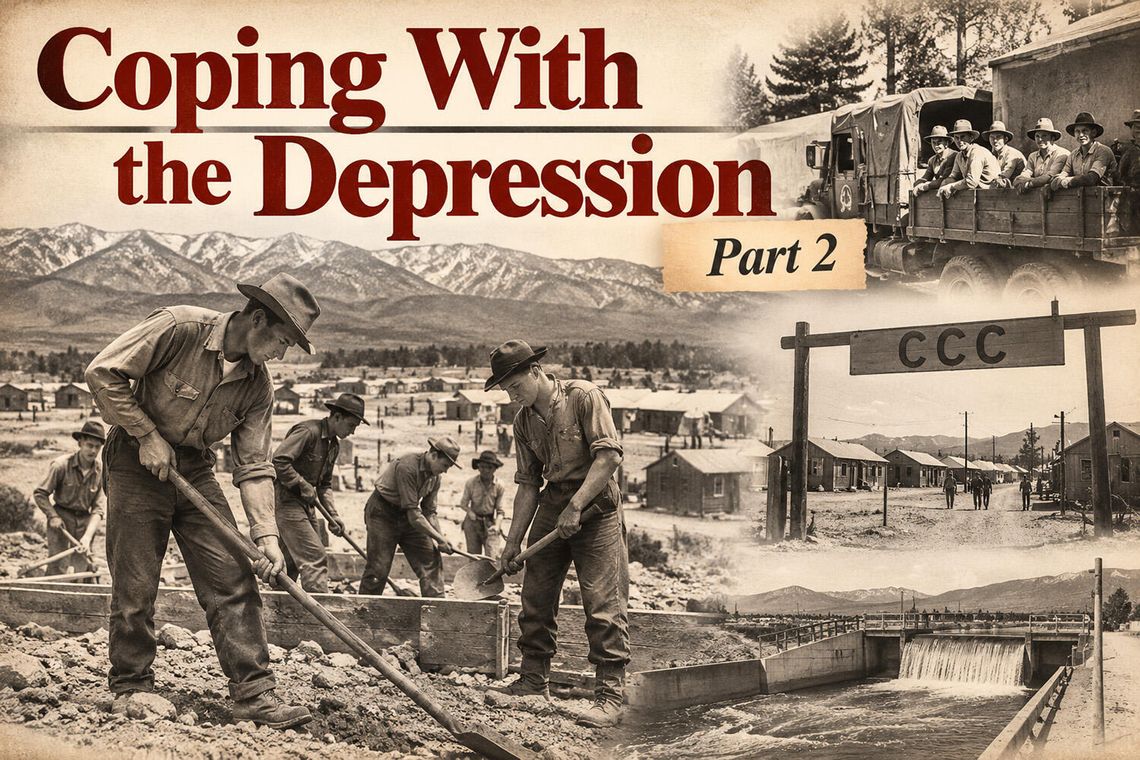
The Great Depression was felt everywhere, widely across the world and specifically in the small rural community of Fallon. I wrote last week that, although Fallon folks suffered in ways similar to others, a few unique factors gave us a boost.
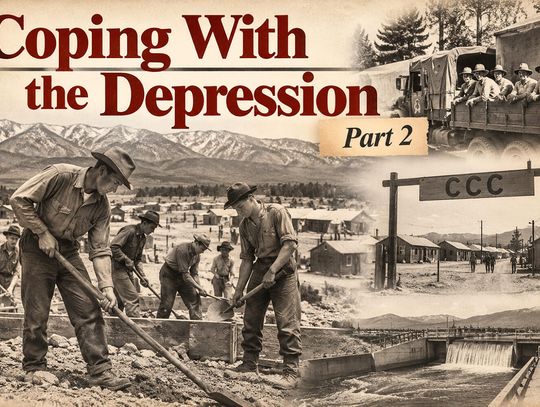
Of considerable benefit was the establishment of not one, but two CCC (Civilian Conservation Corps) camps within the city limits, Camp Carson and Camp Newlands. Both were located in Churchill County because of the importance of the Newlands Project as a Reclamation prototype and because of the poor condition to which Lahontan Dam and the canal infrastructure had sunk as the Great Depression set in.
The CCC, in general, became the most popular of all the New Deal programs, primarily because it visibly infused money into host communities like Fallon. The program provided funds to shelter, clothe, feed, train, and transport the “boys.” Local merchants provided their wares as commissioned. Wages were paid to civilian employees, and contracts were let for building supplies and transportation. The enrollees also received pocket money to spend locally.
In an Oral History held by the Churchill County Museum and Archives, Louis Moiola, working as a carpenter for the CCC, touched on the subject of money spent on and by the local CCC boys.
Moiola: “Well, I was working for the District and Mr. Wallace [Walter Wallace] the Superintendent of the District, got me the job. They needed a carpenter, so they put me on. So I went to work for them and worked five days a week. … [I was paid] Thirty-three dollars a week. I was at Newlands Camp…Br 34…located up there at the District yard [North Taylor Street].”
Moiola’s description of a day’s work for the CCC provides a sense of how many people and dollars were involved.
Moiola: “We'd pick 'em up in the mornings, say at eight o'clock, and they'd have their lunches and everything all made for them--so they'd [Camp personnel] take them out [in Army trucks]. And you'd have one leading man…like a Sergeant. When we were going to put in a concrete structure, we'd have another truck, a flatbed, to take the forms and stuff out. So we'd get another driver, and we'd go out there, and we'd take the structure out, and then we'd put it together, and maybe it'd take us two days to put in the structure. It would depend on how big it was… we worked them about six hours.”
When asked about the food they ate, Moiola said, “It was good food. They had sandwiches most of the time for out in the field. They made sandwiches every day for them, and then they'd send out a coffee pot and coffee, sugar, and one kid'd take a half hour before we'd set down to eat and he'd make up all the coffee so we'd have something to drink. And every once in awhile we chipped in a little money, and we use to be able to buy pies for twenty-five cents a piece. So we used to put up some money, and we'd always stop by the bakery on our way out and buy day-old pies for twenty-five cents. We had to get them in for chow and everything, but six hours work we'd get out of them.” Moiola noted that supervisors, cooks and medical staff were employed at each camp.
It’s difficult to arrive at precise economic figures, but it is estimated that each camp operated on a budget of $180,000 to $300,000. $300,000 would be the equivalent of over $7 million today. And there were two Fallon camps! In a community suffering from falling farm prices, bank failures, and unemployment, even the lower figure seems hefty enough to shore up grocery and dry goods stores, lumberyards, dairies, gas stations, and, yes, bakeries.
A companion version of Moiola’s story played out in 59 camps across Nevada and in 2,900 camps spread throughout the United States. It’s hard to overestimate the economic and social impacts on host communities.
As a side note, did you know that Eleanor Roosevelt sponsored her own female version of the CCC camps, referred to as She-She-She Camps? They served about 8,500 women as compared to more than 3 million men who participated in the CCC. The camps fell under the management of the Federal Emergency Relief Administration (FERA) rather than the CCC, and the program did not include Nevada sites. The first camp, Camp Jane Addams, was built in New York and focused on forestry training. After a national outcry—women should not be working, especially in forestry—FERA switched gears to emphasize training in education and home economics. Depending on the camp’s location, women learned to sew, repair playground equipment, create visual training aids for public schools, type, cook, and can foods.
Please send your stories and ideas for stories to [email protected].












Comment
Comments