
 Leanna Lehman
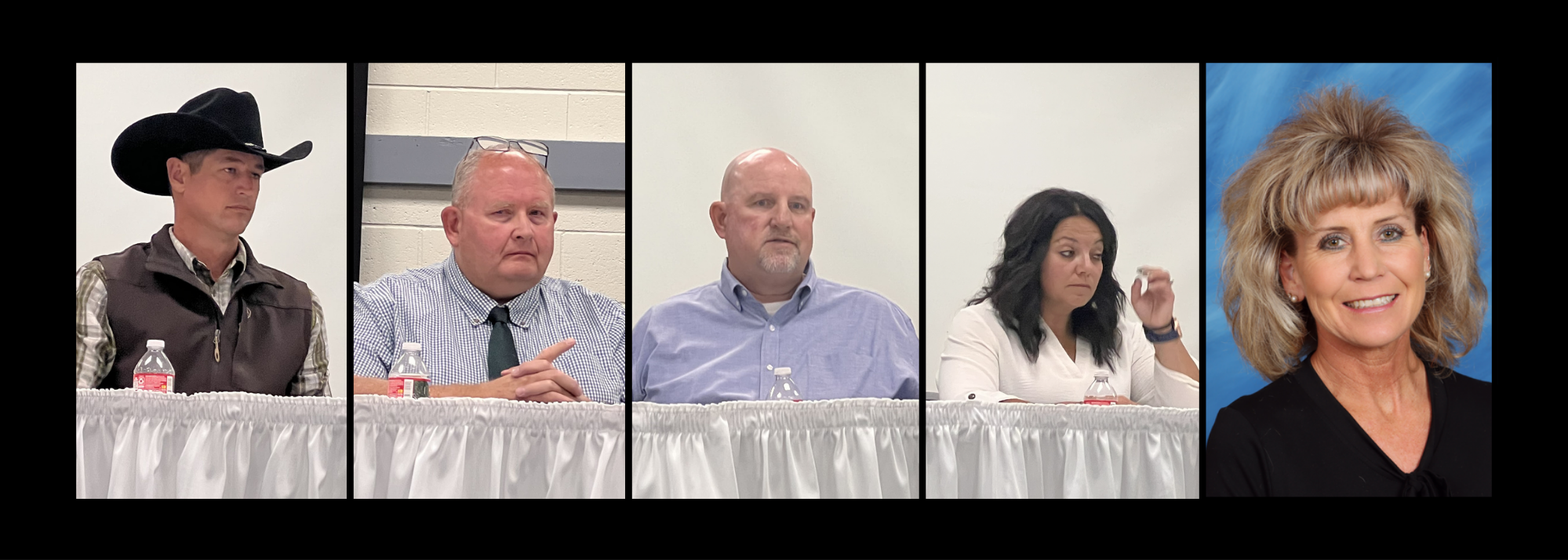
Candidates for the Churchill County School District Board of Trustees addressed declining academic proficiency, career and technical education, financial challenges, and school board governance during Candidates Night on Tuesday, Oct. 6, at the Fallon Convention Center. Steve Ranson, editor emeritus of the Lahontan Valley News, and Rachel Dahl, publisher and owner of Range Media/The Fallon Post, moderated the forum.
The event was broadcast on KVLV 980 AM and KKTU 99.5 FM and livestreamed at Network1Sports.com, where a replay is available with a subscription.
Four candidates — Celestia Blakey, Keith Boone, Joe McFadden, and Derild Parsons — participated in the forum. Amber Getto was unable to attend because of her son's wedding. Ranson read excerpts from her written responses to candidate questions.
The candidates' responses are presented alphabetically by last name rather than in the rotating speaking order used during the forum.
Student Achievement and Testing
Recent state data show that fewer than three in 10 Churchill County students in grades three through eight are proficient in English language arts, and about one in five are proficient in math. Standardized tests are only one measure of student achievement, so beyond test scores, how should the school board determine whether students are actually learning what they need to know, and what specific actions should the board take when students are not meeting those expectations?
Celestia Blakey: Blakey, who was appointed to the school board after Matt Hyde was elected as a county commissioner, said standardized test results do not always reflect the progress teachers see in their classrooms. She supports continued implementation of the district's adopted curriculum and additional assistance for students who need it. "I don't want people to think that our kids are not making progress because our test scores don't show those numbers," she said.
Keith Boone: Boone, a recently retired Churchill County School District principal, cited student health, happiness, and attendance as important factors in academic performance. "Another thing that compounds a child's learning is just being in school," said Boone. He supports greater use of school social workers and wants the district to examine reducing computer time for younger students in favor of books, writing, and face-to-face learning activities.
Amber Getto: In written comments read later in the forum, Getto, who is also a school board trustee, identified student achievement as a priority and emphasized addressing behavioral problems that disrupt classroom instruction. She said the district needs to address behavior effectively so teachers can teach and students can learn.
Joe McFadden: McFadden questioned the amount of instructional time devoted to state testing and data collection, saying the district should advocate for reducing redundant assessments.
"We need to we need to go back to trusting our teachers," he said, stating that teachers work directly with students and recognize progress that may not be reflected in state reports.
Derild Parsons: Parsons, who recently retired as district superintendent, acknowledged the district's academic challenges but said standardized testing does not capture every measure of student success. He supports maintaining rigorous, adopted curriculum over several years rather than repeatedly changing instructional approaches. "If you don't stick with something for 5 to 7 years, it's not going to work," he said, referring to the need for consistency in educational programs.
Work-Based Learning and Career Preparation
How important is it for the school district to have a program that allows students to job shadow or intern for a local business? How do you support that program and work with the Churchill Entrepreneurial Development Authority (CEDA) to achieve success?
Celestia Blakey: Blakey supports expanding partnerships with local employers and teaching students workplace expectations, including punctuality, appropriate dress, and communication skills.
She stressed the importance of creating local employment opportunities for graduates. "All we're going to do if we don't is just raise the kids and send them with great skills to outside communities or other states," she said.
Keith Boone: Boone supports vocational and technical education opportunities, particularly those connected to northern Nevada industries. He described the value of students experiencing career opportunities firsthand, calling it "hands on" education. Boone also said the district and participating businesses should establish clear expectations and determine whether students are prepared for internships before placing them with employers.
Amber Getto: Getto supports expanding career and technical education programs that provide hands-on experience and help students explore employment opportunities. In her written response, she emphasized working with local businesses to identify barriers to participation.
She also supports continuing the district's partnership with Western Nevada College, which allows high school students to earn college credits.
Joe McFadden: McFadden, who serves on the high school's work-based learning advisory committee, described efforts to help graduating seniors develop individual plans for college, trade schools, employment, or military service. He said he strongly supports preparing students to become productive members of their communities and encouraging them to return to Churchill County after completing their education or training.
Derild Parsons: Parsons said partnerships with local businesses help students identify career interests and develop workplace skills while still attending school. He emphasized that students have different educational and career goals and that internships can create employment opportunities after graduation. He said schools must recognize that "everyone is looking to be on their own path."
Priorities for the Next Term
What is the one big change, issue, or improvement you would like to see occur, or would advocate for, during your term on the school board?
Celestia Blakey: Blakey identified consistent implementation of the district's adopted curriculum as a priority, particularly as students transition between grade-level schools. She wants appropriate interventions for students who fall behind and continued efforts to recognize district employees. She described teachers as "the heart and soul of our education."
Keith Boone: Boone would like the district to consider restoring an alternative high school program. Drawing on his experience as principal of the former Lahontan Valley High School, he said some students who struggle in traditional school settings can succeed when provided with a smaller, more supportive environment. "It wasn't a fact of that they didn't have the academic skills. It was a fact that they needed to be in a program where they felt supported," he said.
Amber Getto: Getto identified improving student achievement and academic performance as her primary goal. She emphasized addressing behavioral challenges that interfere with classroom instruction and maintaining an environment where teachers can teach, and students can learn.
Joe McFadden: McFadden said his priority is preparing students for life after graduation, beginning in kindergarten rather than waiting until high school to address learning gaps. "It's not simply prepared to pass a test or receive a diploma," he said.
He also supports consistent curriculum implementation and continued advocacy for increased state funding, particularly for rural school districts.
Derild Parsons: Parsons identified consistency as his primary goal. He supports maintaining adopted curriculum, academic expectations, behavioral support systems, and instructional resources rather than abandoning initiatives before they have sufficient time to produce results. "I think for me, the biggest change needs to be maintaining some consistency," he said.
School District Finances and Declining Enrollment
As you know, counties around the state have experienced financial shortfalls, including Elko, Douglas County, and Carson City. Several rural school districts have experienced tremendous budget shortfalls, school closures, and staff layoffs. How do we avoid that in Churchill County?
Celestia Blakey: Blakey said trustees must carefully evaluate financial information and enrollment projections provided by district staff. Because state funding is tied to student enrollment, she emphasized balancing staffing levels, classroom sizes, and available resources.
She said trustees have a responsibility to make sure district officials provide accurate projections so the board can make informed decisions.
Keith Boone: Boone encouraged realistic enrollment projections and adjusting staffing as student populations change. He suggested reassigning existing teachers where appropriate before hiring additional staff, including retired educators working in critical-need positions.
He said districts must prepare for changes in enrollment rather than assuming staffing needs will remain the same.
Amber Getto: Getto said the district has managed its resources responsibly and avoided the severe budget deficits experienced elsewhere. "Maintaining financial stability requires careful planning, responsible stewardship, and a continued focus on directing resources where they have the greatest impact on our students and teachers," she wrote in a response read by Ranson.
On outsourcing services, she said decisions should consider costs, service quality, employee impacts, and long-term consequences.
Joe McFadden: McFadden identified declining enrollment and rising expenses, including insurance, salaries, and contracted services, as significant challenges. He said trustees must evaluate competing spending priorities and make difficult decisions about how available funding can best serve students. "No one wants to close a school. That's not good for a community," he said.
Derild Parsons: Parsons emphasized fiscal responsibility, careful enrollment projections, and continued advocacy for state funding. He explained that enrollment changes can affect district revenue and require staffing adjustments.
"The funding is simply tied to enrollment," he said, adding that the district must plan carefully when student numbers decline.
Independent Oversight and Former Administrators
With the possibility of several retired school administrators serving on the board, how can trustees provide independent analysis and objectively represent the community as a whole, rather than viewing decisions primarily through their experiences as educators or administrators?
Celestia Blakey: Blakey expressed concern about the possibility of three former administrators serving on the board, while acknowledging their qualifications.
"I'm slightly terrified that the fact that we could have three administrators on that board," she said. Blakey said her perspective as a parent with a child currently attending district schools and as a local business owner provides a different viewpoint.
Keith Boone: Boone said serving as a trustee differs significantly from working as a school administrator. He pledged to approach decisions with an open mind, consider differing perspectives, and support decisions made collectively by the board. "I don't think it's all that bad of a thing to have a little bit of school background going into this," he said.
Amber Getto: Getto's response to this question was not included in the excerpts read during the forum.
Joe McFadden: McFadden emphasized the importance of having diverse professional experiences and perspectives represented on the board. He cited his background in business ownership, electrical contracting, volunteer service, and four years of school board experience as qualifications that complement those of former educators.
Derild Parsons: Parsons, the district's former superintendent, acknowledged concerns about his transition from administrator to trustee. "I don't expect to be still the superintendent to have that capacity. I expect to be a board member," he said.
He noted his previous work outside education, his longtime involvement in Churchill County, and his commitment to representing the community as one member of a seven-person governing board.
Each candidate was sent questions in advance.
Candidates Night was presented by The Fallon Post and Lahontan Valley News, with broadcasting provided by Lahontan Valley Broadcasting Co., including Lynn Pearce, managing partner of KVLV 980 AM and KKTU 99.5 FM, and broadcaster Larry Barker. Special thanks go to Gary Smith, who helped organize Candidates Night during the COVID-19 pandemic to bring candidates and their views to the public, and Assemblyman Greg Koenig for their support of the event.










Comment
Comments