

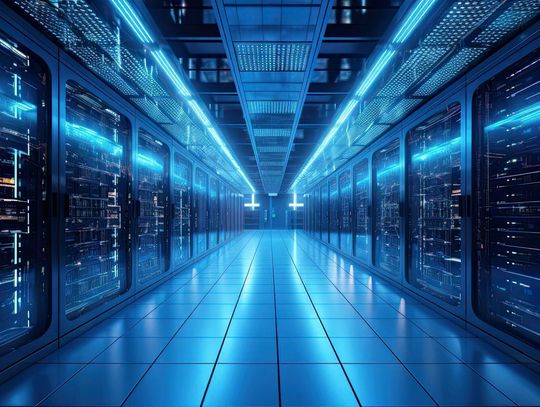
Data centers have become the subject of an increasingly heated debate in Nevada. Residents are understandably concerned about the amount of water and electricity these massive facilities may consume — and whether ordinary families will end up paying for the infrastructure needed to serve them.
Those are fair questions. Nevada is the driest state in the nation, and the recent issue with the Colorado River Commission and subsequent lawsuit shows that our state leaders are serious about protecting our limited water resources.
No company, no matter how large or technologically important, should receive a blank check to consume scarce resources or shift its costs onto Nevada ratepayers.
But the debate also needs to be based on facts. Nevada is not ignoring these concerns. State and local leaders, water authorities, regulators and NV Energy are taking steps to ensure that data centers are developed responsibly and that the companies benefiting from them bear the costs they create.
Governor Lombardo recently signed an executive order that requires applicants to pay the Local School Support Tax in full, bear the costs associated with serving their facilities rather than shifting them to other utility customers, meet local water standards and enter into a binding Community Support Commitment. These seem like reasonable requirements.
Modern data centers can be designed very differently from the water-intensive facilities of the past. Closed-loop cooling systems recirculate water rather than continuously consuming new supplies.
Storey County utilizes treated effluent and recycled wastewater — rather than drinking water — to support industrial operations and cooling needs at the Tahoe-Reno Industrial Center. That is actually an efficient reuse of the region’s water resources and improves water quality in the Truckee River.
Air-cooled technology can reduce onsite water use even further. Southern Nevada has already prohibited new evaporative cooling systems, and some recently approved data-center projects are expected to use only a small fraction of the water consumed by older facilities.
Nevada should consider making these modern cooling practices the standard for projects receiving state tax abatements. If a company wants a public incentive, it should be required to demonstrate that it will protect Nevada’s water resources.
The same principle should apply to electricity.
As the governor’s executive order stated, data-center customers must pay upfront for the transmission, distribution and other infrastructure needed to serve their projects. That is an important ratepayer protection.
Some projects are also considering dedicated or behind-the-meter generation, allowing them to provide some or all of their own electricity rather than placing their entire demand on the existing grid. That approach can help protect reliability and existing customers, although Nevada must still examine the fuel source, emissions and long-term consequences of any onsite generation.
These safeguards do not mean Nevada should stop asking questions. On the contrary, every major data-center proposal should disclose its expected electricity demand, water consumption, cooling technology, backup-generation emissions and infrastructure requirements. Developers should explain how many permanent jobs they will create, what taxes they will pay after abatements and what financial guarantees will protect the public if a project is delayed or abandoned.
Accountability is not opposition; it is responsible economic development.
At the same time, Nevadans should be aware that not every alarming claim circulating online comes from a neighbor acting in good faith.
In June, OpenAI disclosed that it had disrupted a covert influence campaign operated by accounts likely originating in China. The campaign — dubbed “Data Center Bandwagon” — used artificial intelligence to create posts, comments and cartoons criticizing American data centers and claiming that they were driving up electricity costs for ordinary families.
The operators posed as Americans from different walks of life and used legitimate news stories to make their manufactured personas appear credible. According to OpenAI, the operation was likely connected to a private Chinese technology company that performed work for Chinese provincial-government clients.
More recently, X announced that it had identified a large network of suspected Chinese inauthentic accounts, including accounts attempting to manipulate the American debate over AI, data centers and energy policy.
Why would China care whether Nevada and other states build data centers?
Because data centers are the physical backbone of artificial intelligence. The nation with the greatest computing capacity will have an enormous advantage in commerce, medicine, national defense, research and virtually every other field. China has made no secret of its desire to surpass the United States in artificial intelligence. Slowing America’s ability to build the infrastructure that supports AI would serve China’s strategic interests.
This does not mean every person questioning a data center is spreading Chinese propaganda. Most concerns expressed by Nevada residents are genuine. It would be unfair — and counterproductive — to dismiss legitimate local opposition as the work of foreign agents.
China-linked operatives did not invent an entirely fictional issue. They attempted to take real concerns, remove important context, amplify fear and turn Americans against one another. That is how modern influence operations frequently work.
Nevadans should refuse to be manipulated from either direction. We should not accept unsupported claims from data-center companies, and we should not automatically believe frightening social-media posts designed to generate outrage.
Nevada has an opportunity to help lead America’s technological future while protecting the resources that make our state livable. We can also reap economic benefits that will help our cities, counties and schools prosper. That is one reason the Clark County Education Association recently announced its strong support for data centers. The association sees them as a way to better fund education in Nevada.
Nevada should welcome the technology of the future — but only on terms that protect Nevada’s water, Nevada’s power system, Nevada’s people and Nevada’s economy.
Randi Thompson is a political and public relations consultant in Reno.











Comment
Comments