
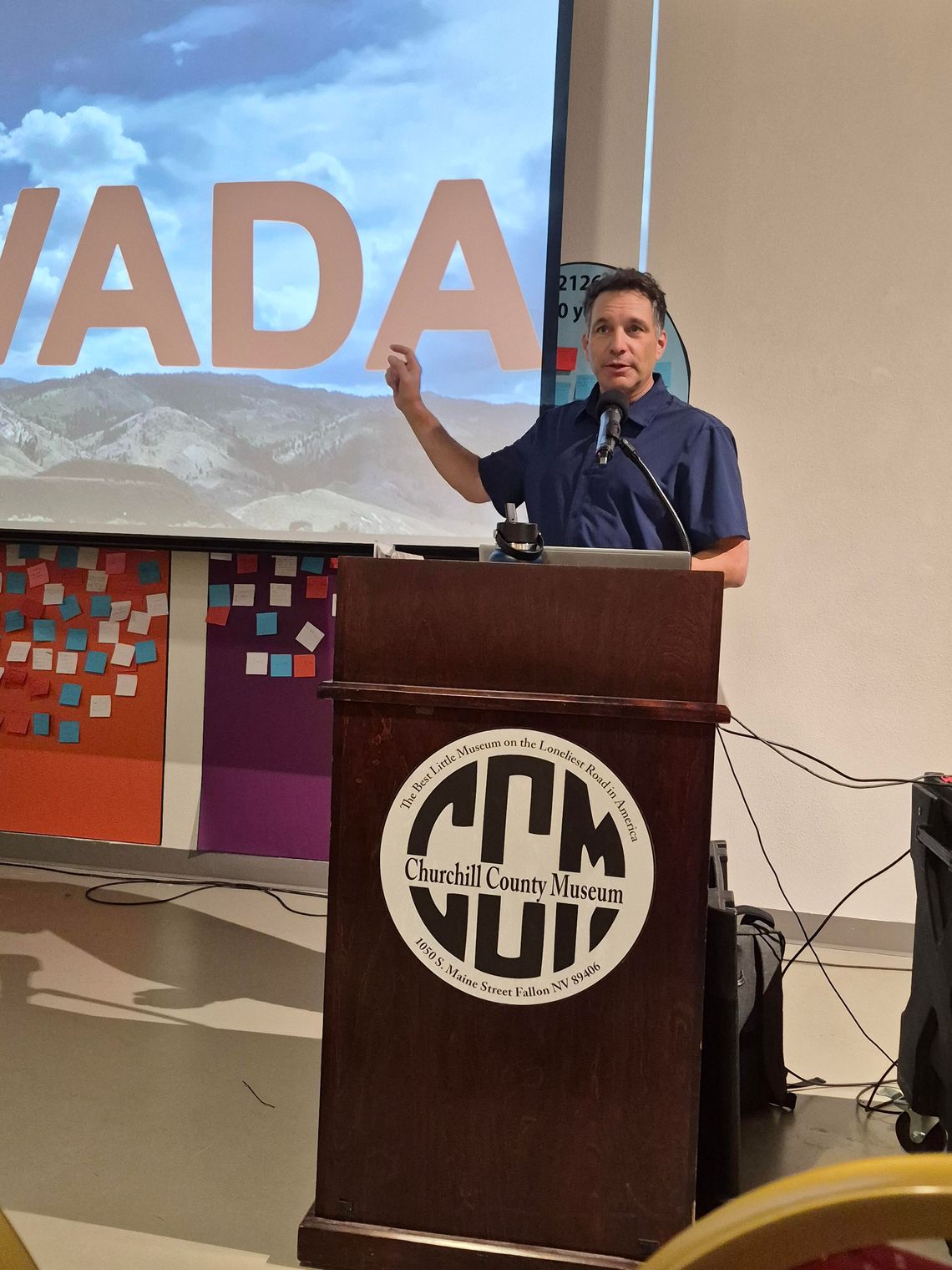
Dave Santina has spent more than two decades climbing Nevada peaks, crawling into caves, jumping from an airplane and, once, crashing a bicycle hard enough to become the subject of a young viewer’s drawing.
But when the longtime host of PBS Reno’s “Wild Nevada” talked about the layers of the state at the Churchill County Museum on Sept. 15, the places and adventures were only part of the story. The people he met along the way, he said, mattered most.
Santina, PBS Reno’s director of local content and host of the “Wild Nevadacast” podcast, was the second speaker in the museum’s fall lecture series, “The Layers of Nevada.” Using clips and photographs from the program, he took the audience through 25 years of back roads, small towns, remarkable scenery, and the occasional mishap.
The television series began in 2000 after producer Jack Kelly, who had moved from Illinois, started exploring his new home. His curiosity became a travel show designed to take viewers beyond Nevada’s highways and city limits.
The first episode began close to Fallon at Grimes Point. Since then, the program has produced 104 episodes, even with a 12-year break in production. Santina appeared as a host in roughly 80 to 85 of them.
From the beginning, the goal was not simply to show viewers beautiful places. Santina wanted the trips to feel possible.
“Don’t watch us and sit on the couch,” he said. “Go and do it. Go and visit.”
That invitation took viewers to Cathedral Gorge, Little Finland in Gold Butte, Lamoille Canyon, and McLane Peak. Santina recalled committing the crew to the difficult McLane Peak climb, which they completed despite one member wearing slip-on boat shoes.
Santina’s photographs showed how dramatically Nevada can change from one end of the state to the other — desert formations, mountain lakes, caves, and high-country trails that hardly look as though they belong within the same borders.
“This is one state,” he said, still sounding surprised by its variety.
Some of the stories were closer to home. Santina described trips to Sand Mountain and a 2014 program in the Fallon area with wildlife photographer Larry Neel. Neel later returned as a guest on “Wild Nevadacast” to discuss his book, “Shadows in the Sagebrush,” and the patience behind his wildlife photographs.
The program also introduced Santina to people who knew Nevada in ways no map could show. McLane led the crew to a nearly hidden cave he had not visited since the 1960s. In Eureka, the late Wally Cuchine guided viewers through restored buildings and showed why the small mining town remained very much alive.
Those guides turned places that had seemed like points on a map into communities with memory and character.
“I get to see a place that somebody loves through their eyes and understand why they love it,” Santina said.
The work also taught him when to step back. At Spirit Mountain in southern Nevada, he learned more about the site’s sacred importance and the responsibility to respect places that do not belong to a television crew simply because a camera can reach them. On trails, he heard the rule to leave no trace again and again.
Santina did not leave out the less graceful parts of making a travel show. He showed the audience footage of himself struggling on a climb, overturning a kayak, and crashing a bicycle. The mistakes, he said, belong in the story, especially when they can keep someone else from taking an unsafe risk.
“We need people to know that if you’re having a hard day, if you’re not feeling right, you need to be honest about it and stop,” he said.
Those moments also created one of his favorite memories. A father and daughter in Gardnerville sent Santina drawings of his bicycle crash. In the daughter’s version, Santina was covered in red, his co-host warned him to be more careful, and even the crew’s minivan appeared alarmed.
Santina still keeps the drawings in his desk.
Three years ago, with his daughter nearing the end of high school, Santina left the travel schedule behind. Through “Wild Nevadacast,” he found another way to talk with rural writers, historians, artists, filmmakers, and photographers whose stories do not always fit into a television segment.
“The most important part of this to me is the people,” he said. “It’s more important to me to be able to talk about this and to share it with people than to just go and experience it by myself.”
I left the museum thinking about the places Santina showed us and how many are close enough to visit. The lecture was another part of my own journey to learn about the place I have lived for so long — and a reminder that there is still plenty here to discover.
The museum’s “The Layers of Nevada” lecture series continues with historian Joe Curtis at 6 p.m. Sept. 29 at the Churchill County Museum, 1050 S. Maine St. Admission is free.







Comment
Comments