
 Leanna Lehman
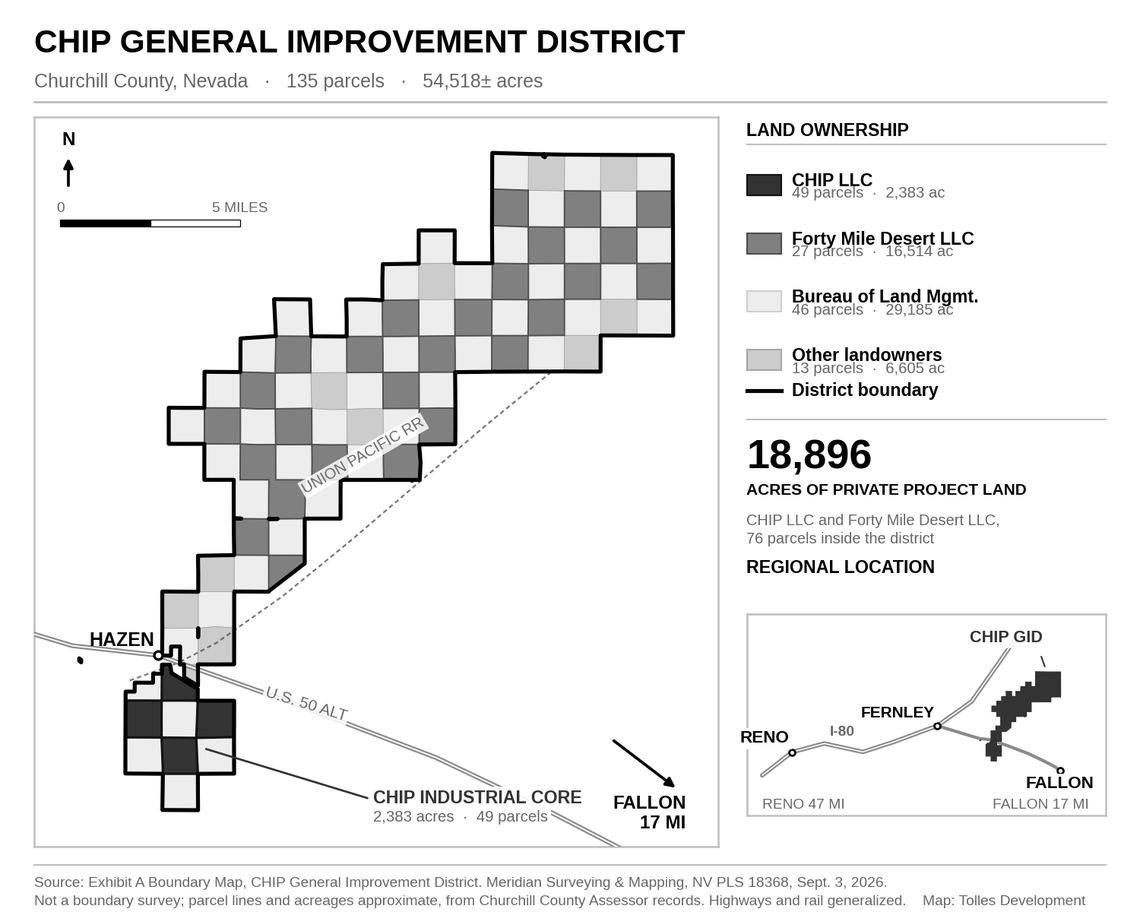
Or at least, that is the hope for Tolles Development Company. For decades, Churchill County has envisioned industrial development near Hazen. One stubborn problem has repeatedly stood in the way: infrastructure — particularly power.
Now, an unusual solution may solve that problem: Tolles is proposing to develop a power system capable of serving the planned industrial park and create a public general improvement district, or GID, to deliver essential services.
That proposal moved a step forward Sept. 16 when the Board of County Commissioners set an Oct. 15 public hearing on the district’s service plan and conducted the first reading of an ordinance initiating creation of the Churchill Hazen Industrial Park (CHIP) GID. The actions did not create the district; additional public hearings and county approvals are required.
Industrial users need reliable power before committing millions, or potentially billions, of dollars to a site. Utilities, however, generally need committed customers before making major investments in generation and transmission infrastructure. Cory Hunt, a principal with Tolles Development Company, explained, “It just always ends up being this self-fulfilling prophecy … ‘we don't have any power because we don't have a customer because we don't have any power.’”
Hunt said developers approached NV Energy about bringing additional power to the site but were told the infrastructure could not be available until 2032.
“So that's where the general improvement district comes in,” Hunt said.
Hunt said the Hazen property has been identified for industrial development for roughly 25 years. The late Tim Tucker was involved in earlier efforts to develop the property, and Tolles later began working with Tucker’s estate and other partners to move the project forward.
Hunt pointed to Castelion as an example of an industrial opportunity Churchill County lost. He said efforts were made to bring the defense technology company’s larger manufacturing operation to the area, but it ultimately went to New Mexico, where the project is expected to generate more than $650 million in economic output over 10 years.
Hunt said approximately 2,300 acres south of U.S. 50A are intended for industrial development, including areas for water and wastewater infrastructure. The roughly 54,000-acre proposed GID extends north of the highway primarily to encompass areas needed for power generation and delivery.
Developers are looking for advanced manufacturing, rail-oriented development, and other industrial users that fit Churchill County, Hunt said. “We've been looking for companies that are a good fit for the Fallon community,” he said. “Good-paying jobs that are stable, that you can build a career around and build a family around.”
The project envisions a combination of natural gas generation, solar power, battery storage, and, eventually, geothermal energy. Hunt said those resources could operate as a behind-the-meter system serving the industrial park without relying on the existing electrical grid.
“Combining all those resources together we can build a completely islanded power facility that generates all of its own power,” Hunt said. Under the proposed structure, generating facilities would remain privately owned. Power would be sold to the GID, which would then provide electricity to customers within the district.
Because the proposed system would operate independently, Hunt said it would not place the cost of CHIP’s electrical infrastructure on existing utility customers. “It's not touching the grid, so there's no impact on ratepayers,” Hunt said. “No one's rates are going to go up.”
Water is another consideration. Hunt said CHIP controls the water it expects to need and is not seeking additional water rights. The property has existing wells and monitoring wells, and recent pump testing has been conducted to understand sustainable groundwater production more fully. Water use would remain subject to regulation by the Nevada State Engineer, Hunt said.
The proposed service plan also prohibits large-scale evaporative cooling, with closed-loop and dry-cooling systems contemplated instead.
Hunt said the intent is to build shared infrastructure rather than require each industrial user to develop its own wells, wastewater system, roads, and other essential services.
Hunt said he is available to visit with residents after county meetings to answer questions.
“I think we can hear the real concerns from the community and hopefully alleviate some of those,” Hunt said. “And if we don't have a good answer, or haven't thought about it, maybe we can address it up front so that we can make sure that it is a good thing ultimately.”














Comment
Comments