
 Michon Mackedon
In the early Fallon newspapers, there are constant reminders that some things remain the same over many years. For example, a driving political force, then and now, was the pocketbook.
Fallon was incorporated as a city in December 1908, but not without great internal dissent. We were, like our state of Nevada, “Battle Born.”
The division was not red versus blue but rather “knockers” versus “boosters.” So, what was that all about? It was about taxes.
The “boosters”—those who favored incorporation—rallied in early 1905. A Feb. 25 Churchill Standard article noted that some enterprising citizens of Fallon had started “the wheels a-rolling” for municipal government. Local businessmen and professionals banded together to form the Commercial Club, whose members were dedicated to the tasks of recruiting new citizens and businesses to the community. They cheered the formation of a Fallon Brass Band and a Fallon Literary and Music Society, whose organizational meeting attracted 30 people—a feat that might be difficult to pull off today. The paper also reported in sweeping detail the balls, parades, masquerades, and card parties of an energetic town, claiming that “The people of Fallon are always up and hustling and are boosters at all times.”
The downside of all this growth and energy was the perceived unfairness of the distribution of Churchill County taxes. The Standard lamented in October 1907 that “The county board, which is likewise the town board, under existing conditions, is neglecting discipline in conduct of town affairs.”
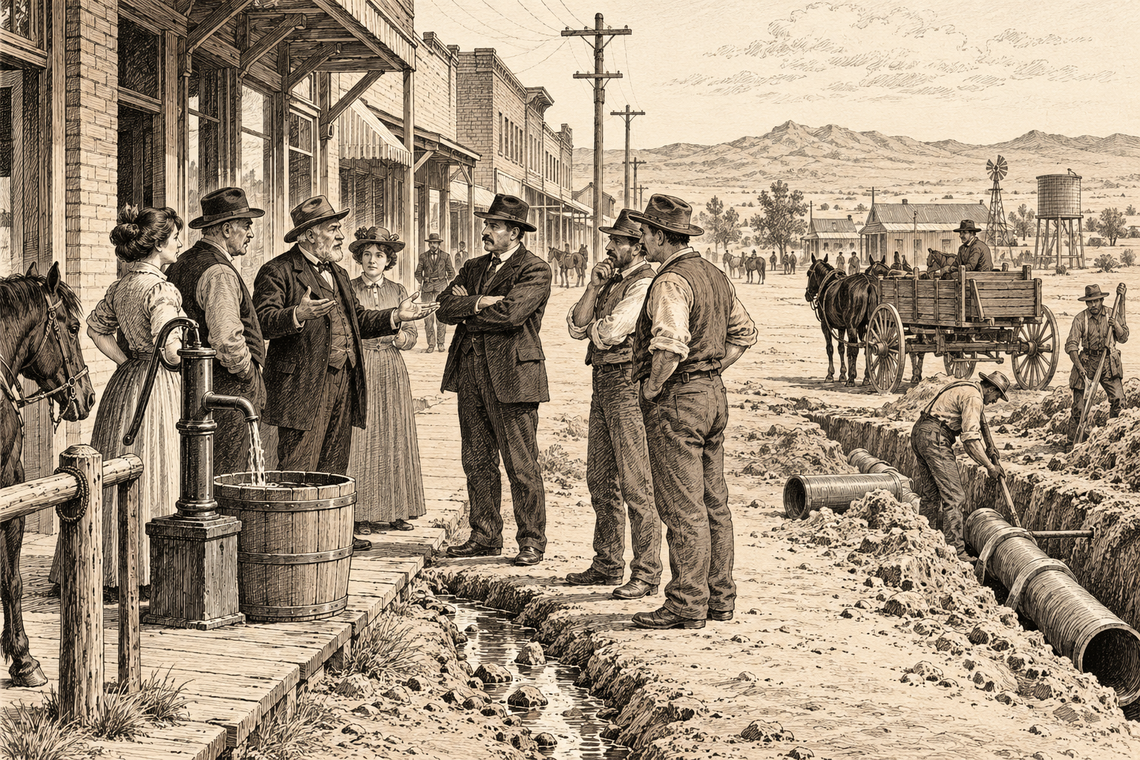
In short, Fallon businesses clamored for more services, especially sewer and water. The campaign for incorporation was closely linked to the need for both. The Standard, always a booster, pleaded for incorporation, using the dramatic and overwrought style typical of the era: “The main consideration is health. …It is the greatest blessing know to humanity. Who can tell how deaths of those dear ones sleeping beneath the sod in the cemetery of the hill are directly attributable to the unhealthy conditions extant in Fallon? A sewer and water system will remedy this evil.”
But sewer and water would cost money, hence raise taxes. Those who opposed incorporation were labeled, at least by the newspapers, “knockers.” The Standard began using the phrase as early as 1906, remarking that it was important to keep newcomers away from knockers: “Some knock because they’re born that way; others because they don’t know they’re doing it.”
For a while, the knockers were winning the battle. A special election was held to endorse incorporation in May 1906, but solid opposition to it had grown, and the nays won. If anything, though, the disappointing election spurred on the boosters. The Standard called the county sanitation system “crude and unbusinesslike.” The County Commissioners conceded that the conditions were intolerable and suggested the use of disinfectants, further infuriating the business sector.
Fallon’s second newspaper, The Churchill Eagle, on Oct. 4, 1907, upheld the boosters and defended incorporation: “While the proposal of incorporating Fallon is being contested there is little doubt that the people of the town are very favorably inclined toward the scheme. The only opposition developed has as a basis the supposition that exorbitant taxes will be imposed.”
Meanwhile, the knockers went to court, challenging the constitutionality of Nevada’s General Incorporation Act, which had been drawn up by Churchill County Senator Robert Douglass to clarify the process of incorporation. After more bitter words had been exchanged and several petitions circulated, both pro and con, a final election on the issue was held on Sept. 29, 1908, and, this time, the boosters prevailed. On their election slate were Fallon’s first mayor, J.C. Jones, and councilmen I.H. Kent, C.W. Foote, and M.L. Wildes.
The newly elected City of Fallon officials went to work at once. Ordinance 1 set fees for business licenses. Ordinance 2 fixed the time for meetings of the city council on the first Tuesday of each month, and Ordinance 3 tackled, in part and at long last, the sanitation issue by requiring that urine and offal be contained in a box or other receptacle and made it unlawful for humans to eliminate waste on the streets of Fallon. Three steps forward.
Please send your stories and ideas for stories to [email protected].







Comment
Comments