
 Leanna Lehman
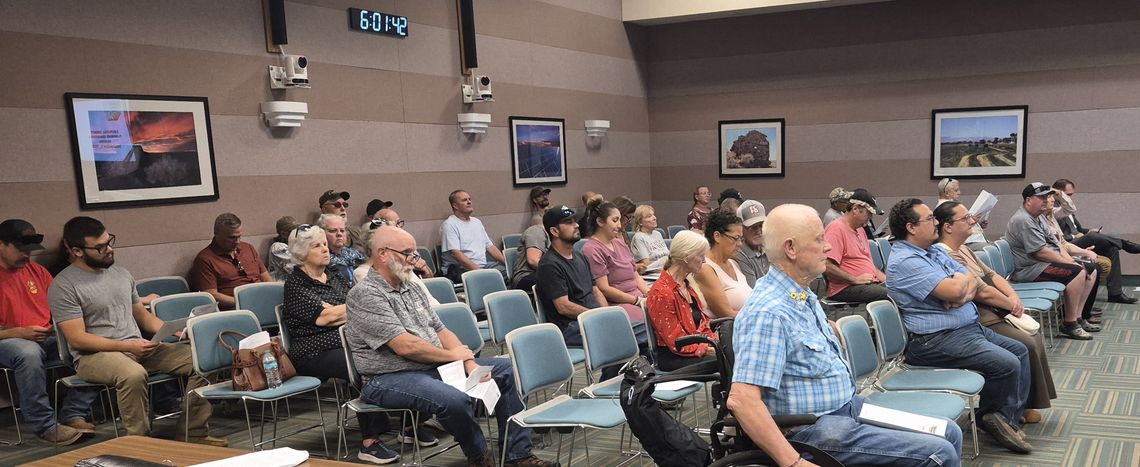
Churchill County is considering new development standards for its industrial zoning districts, including requirements governing data centers, power generation, water use, noise, traffic, and other impacts.
The Planning Commission reviewed the proposed changes Sept. 9 as an informational item with no action taken. The proposal remains under consideration.
The discussion comes as Nevada experiences rapid growth in proposed data center development.
According to the Desert Research Institute, NV Energy’s 2024 Integrated Resource Plan identified 12 new data centers requesting 5,900 megawatts of capacity. Two years later, requested capacity had climbed 180% to 16,530 megawatts.
Data centers, referred to in Churchill County code as “Data Storage and Data Processing Facilities,” are facilities primarily dedicated to computer servers and related equipment used to store, process, and transmit large amounts of digital information. The proposed language excludes data-processing equipment and server rooms necessary to another principal use when they occupy less than 10% of the building.
Churchill County specifically incorporated data storage and processing facilities into its industrial use table during its 2025 zoning overhaul, when the county replaced one industrial district with three: I-1 Commercial Industrial, I-2 Industrial, and I-3 Heavy Industrial. Before those changes, data centers would have fallen under “Warehouse Storage and Distribution” and could have been allowed through a zoning review. The 2025 changes created a separate use for data storage and processing facilities, limited them to industrial districts, and increased permitting requirements.
In recent months, county officials have been taking another look at those standards. During a June 17 workshop, then-interim County Manager Joe Sanford said the technology, type, and scale of data centers had changed significantly. Water consumption, environmental effects, on-site and off-site power, and eventual reclamation of facilities were among the issues identified for further consideration.
At the time, Sanford said the county had no active data center applications. He also discussed a zone change request submitted by Basin and Range Investments LLC, describing it as “a company that works on data related functions,” but said the county had not received an application for an actual use on those properties.
The proposal reviewed Sept. 9 would further divide data storage and processing facilities according to electrical demand: less than 10 megawatts, 10–100 megawatts, and 100 megawatts or more. Permit requirements would depend on both electrical demand and the industrial zoning district.
Under the proposal, data centers in I-1 would require Planning Commission approval and would be limited to facilities using less than 100 megawatts. In I-2, facilities under 100 megawatts could be approved administratively, while those using 100 megawatts or more would require Planning Commission approval. Data centers of any size could be approved administratively in I-3.
Public Works Director Randy Hines explained that the proposed standards also address power supply, water consumption, cooling systems, backup generators, noise, traffic, and visual impacts. Applicants would have to demonstrate sufficient power through a power purchase agreement or plans for on-site generation, often called “behind-the-meter,” in which a facility produces electricity at or near the site rather than relying entirely on the public utility grid.
Water provisions include metering and annual reporting, proof of sufficient water rights, and closed-loop chiller cooling unless a less water-intensive alternative is approved. Closed-loop systems recirculate cooling fluid rather than continually consuming water through evaporative cooling.
Although much of the discussion has focused on data centers, Hines explained that the county is considering standards for industrial development generally, not just data centers, and said the goal is not to make development more difficult. “We're not trying to make it strict or hard,” Hines said. “We're just trying to have clarity within our code.”
Whether those standards provide clarity or create additional barriers became a point of discussion for the commissioners.
Commissioner Joe Frey said the county worked extensively last year to become more inviting to industrial development. “I think this undoes 95% of what we worked for last year,” he said. “I don't want to go back there. I want to keep inviting economic development to our community.”
Commissioner Mark Hyde expressed similar concerns and suggested the county “hit a pause button” before adding requirements.
Planning Commission Chair Tami Edgmon questioned whether large data centers should be eligible for administrative approval without a public hearing. She said the county had less information about data centers when the industrial zoning changes were made last year and suggested the level of public review should be reconsidered.
The meeting also raised questions about the current level of data center interest in Churchill County. Hines said there were no current data center applications, while Senior Planner Dan Cahalane said an earlier application had been withdrawn.
Hines later clarified to The Fallon Post that an application had been submitted for a small, self-contained data center powered by solar. The applicant withdrew it and plans to submit a new application encompassing what Hines described as all 10 phases of the project. That application has not yet been submitted.
During the meeting, Commissioner Mark Hyde referred to what he called “the elephant in the room.”
“We do have a potential project,” Hyde said, describing a company that would provide its own energy and has its own water rights. He added that he wanted to ensure the county was not “putting up unnecessary barriers and discouraging them to be here.”
Hyde did not identify the company or say an application had been submitted.
During public comment, Cory Hunt, a partner with Tolles Development, discussed the Churchill Hazen Industrial Park (CHIP) on Great Basin Parkway in Hazen. County Commissioners rezoned six parcels associated with the industrial park earlier this year for potential uses that included power generation, data storage, and data processing. Hunt encouraged the county to regulate measurable impacts, including water and power demands, rather than particular industries.
“I think there's a lot of opportunities here, and we want to work with you to make that a reality,” Hunt said.
Several residents spoke in opposition to data center development in Churchill County, raising concerns about water and power use, agriculture, the county’s rural character, wildlife, infrastructure, and the protection of Native American sacred sites, cultural artifacts, and potential remains.
Pam Hucke, a local rancher and farmer, questioned what resources would be consumed and who would ultimately benefit. “Rural does not mean empty,” Hucke said. “There are working ranches, farms, watershed, wildlife habitat, family homes, and community built by generations of Nevadans.”
With the proposed standards still under review and a data center application expected, the county has yet to settle where large data centers should be allowed and how much public review they should receive.















Comment
Comments