
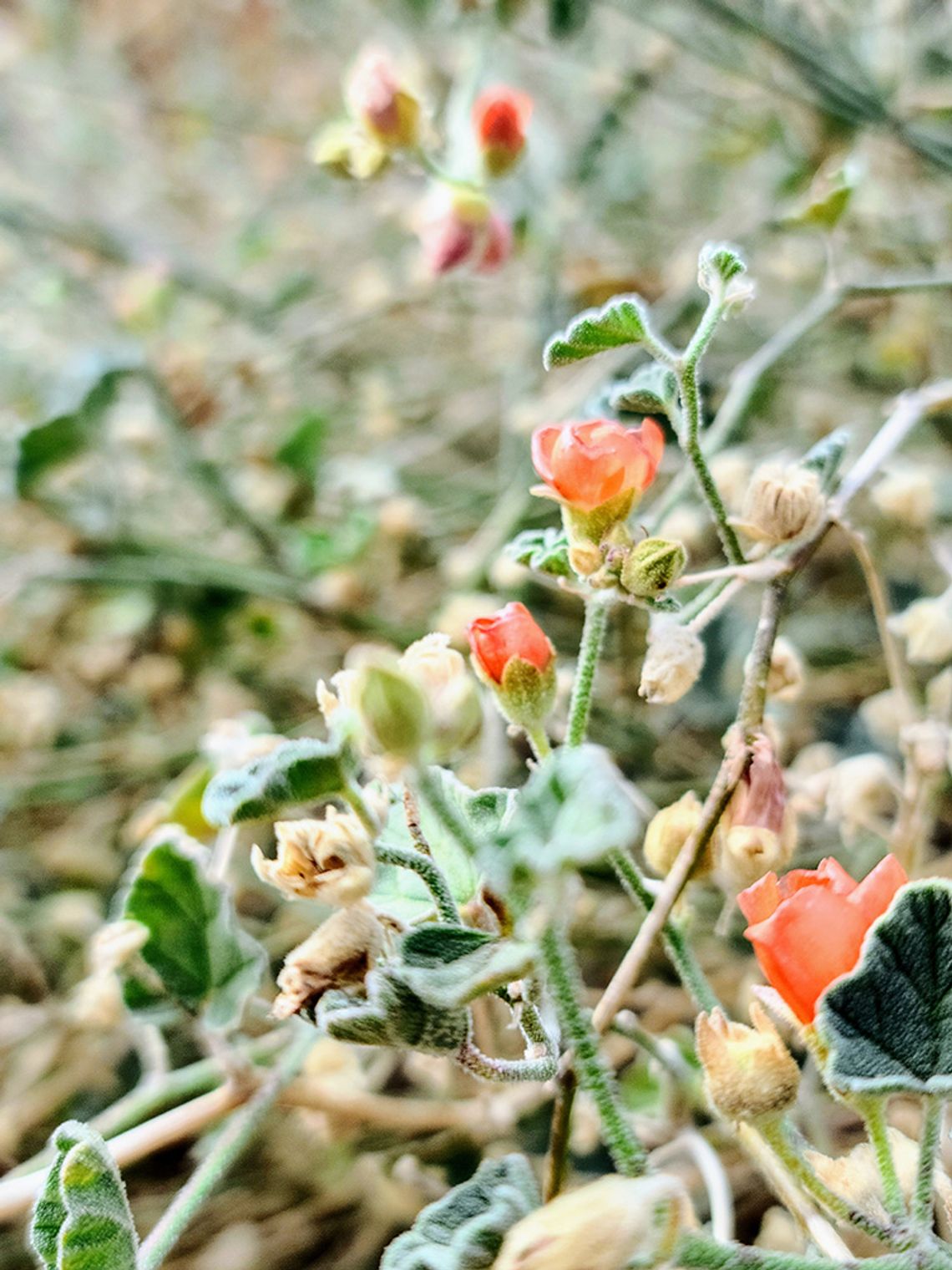
Apricot is not a flower color you see much in gardens beyond roses and irises. The highly ornamental, desert globemallow, desert hollyhock, or more commonly apricot mallow is covered with small, bright apricot-orange flowers usually in the spring, but the plants continue to bloom in response to rain and moisture. This native plant is endemic to the Great Basin and is a must-have for xeriscape friends, pollinator enthusiasts, and native plant gardeners. Where you find dry, open areas with rocky, sandy soil you will often find apricot mallow. I often see it blooming on our hikes just south of town. The plants are grazed upon by pronghorns, bighorn sheep, and deer. Maybe, probably, definitely, seeds ended up in my garden because of those hikes. Being mindful of where you harvest seeds from, now is a great time for hiking and harvesting.
Sphaeralcea muroana is a small, herbaceous perennial, sometimes called a subshrub, that is in the mallow family (Malvaceae). Spharia comes from the Greek word meaning globe. I always feel like I am about to quote a line from the movie, “My Big Fat Greek Wedding” when I start that sentence. Globe refers to the “fruit,” in this case the seedhead. Alcea references a type of mallow. The species name munroana is after Dr. Donald Murano (1789-1853) a famous British garden guru. Apricot mallows have soft grey-green, wooly-like leaves. Botanists refer to the fuzz as pubescence. You might think of it as a plant sunscreen, the tiny hairs break up the sun and dry heat, they also help with water loss.
Apricot mallows will attract checked skipper butterflies and painted ladies to your yard. As well as a plethora of native bees. A few are specialized ground bees from the Diadasia species that take pollen and nectar only from Sphaeralcea and related genera. The Globemallow bee, for instance, is an adorable little bee that makes adorable little “turrets” in the ground marking their home in the sand near the plant. Avoid any extra cultivating or roughing up the soil when you see them.
Interestingly, as it runs around our garden beds, grows profusely in the desert and in abandoned spaces around town, it is quite difficult to cultivate. Germination rates are low and challenging especially in large-scale operations. The tiny, paper brown, thick seedheads are sometimes described as impermeable. Scarification is usually recommended and a cold stratification as well (6 weeks in the fridge). Some people use sandpaper to lightly nick the seed, some people soak seeds overnight in water. A Forest Service scientist in Utah working on restoration actually used boiling water on the seeds prior to planting and saw increased germination. When they can get it to “go” apricot mallows are planted after wildfires, in damaged construction sites, and in the area around abandoned mines. The plants help with erosion control and aid in plant community restoration. The mallow’s hardy nature also helps suppress invasive weeds.
Side note, there is a great need for native seed producers in Nevada. Turns out most native seed planted here for restoration projects isn’t native. The bulk of those seeds come from neighboring western states. The Nevada Native Seed Partnership is made up of quite a few government agencies committed to changing that. For someone looking to start a rewarding side business, I can highly recommend the Native Seed Forum from the Nevada Department of Ag as a place for more information. The folks at Comstock seed in Gardnerville are a resource as well.
In your yard, they grow best in a sunny, sandy location. Be careful not to provide rich soil, fertilizer or too much water. For maximum bloom, you might prune back established plants to the first set of leaves in early spring. Despite the troubles, scientists have in mass cultivation, in your own garden like other mallows these plants can spread. The seeds are plentiful and can lay dormant for many years. Young volunteers can be transplanted to another area of your garden but if you need to remove them completely, I recommend a dandelion digger. Like most desert plants, mallows establish a long taproot. I do not use either in our garden, but I read pre-emergent and glyphosate are not effective means of control. Happy Hiking and don’t forget a bag for your seeds!











Comment
Comments